
How Beginners Should Practise at the Driving Range
Beginners should practise with one clear goal at the driving range: warm up with short, controlled swings, aim at a specific target, and review contact, start direction and ball flight after each shot. Repeat a manageable task until results are sufficiently controlled, then increase club or target variation; reduce difficulty or stop when fatigue makes feedback unreliable.
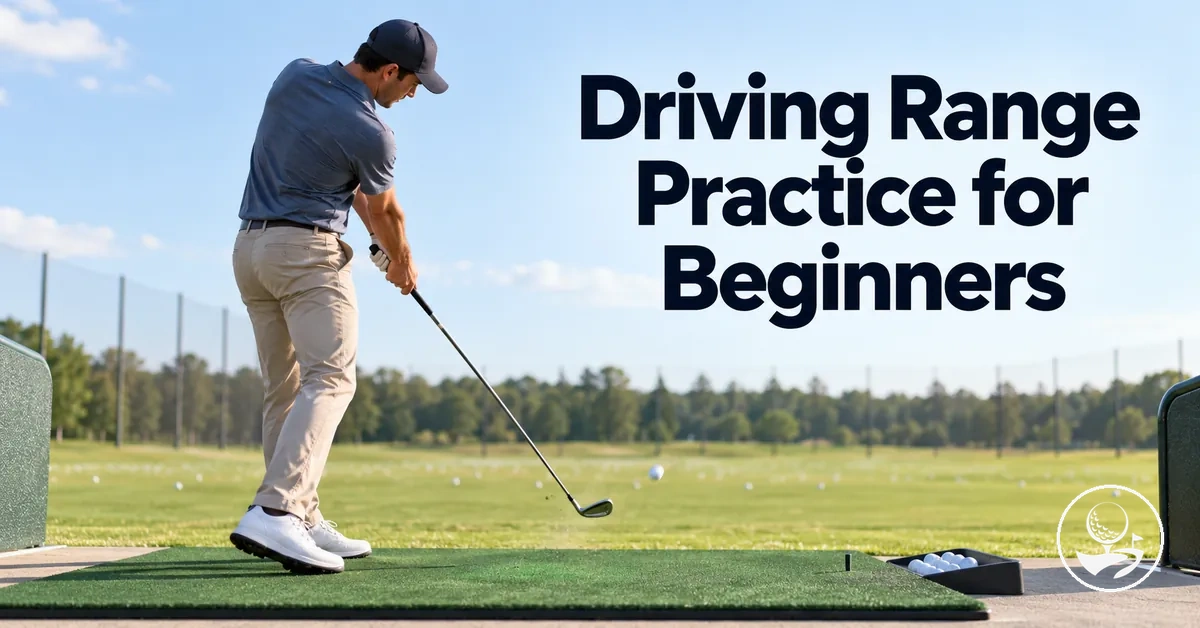
YOUR RANGE SESSION
Plan, practise, check, adjust
Use the same simple loop throughout the session. Keep the task easy enough to observe before you increase the challenge.
- Choose one focus
Pick contact or start direction, and name a clear target.
- Warm up and repeat
Start with easy, shorter swings and a familiar club; work in purposeful blocks.
- Observe each shot
Check contact, initial direction and overall ball flight against the target.
- Adapt the task
Repeat or simplify when control falls; add a club or target change when it holds.
Choose your next practice block
Select your focus and the pattern you are seeing. The guidance changes without assuming a fixed ball count or a swing diagnosis.
Your next block
Use a familiar wedge or short iron with a broad target. Make controlled, shorter swings and give each shot a clear purpose.
Observe: Notice contact quality first, then compare start direction and flight with the chosen target.
Next adjustment: Keep the same club and task or reduce swing effort until contact is manageable more often; do not add difficulty just to use more balls.
Ball-count rule: Allocate only the balls you can hit with time to prepare, observe and reset. Reduce the volume or simplify the task when fatigue or rushed shots reduce useful feedback.
Adapt the number of balls, the clubs you use and the difficulty of each practice block to your available time, current skill and energy. Finishing the bucket is not the goal; each shot should have a purpose and an observable result.
Table of Contents
Prepare for a Focused Driving Range Session
Choose one practical session goal before hitting balls, then make the rest of the range-session preparation serve that goal.
Use the designated hitting area, check that nearby golfers have room and follow the range’s safety instructions before making practice swings.
The chosen skill might be contact, direction or another single practice objective that the beginner can observe while practising.
Club selection, ball allocation and starting intensity should follow that focus rather than introduce competing tasks.
A focused plan should make the first practice task clear before the first swing.
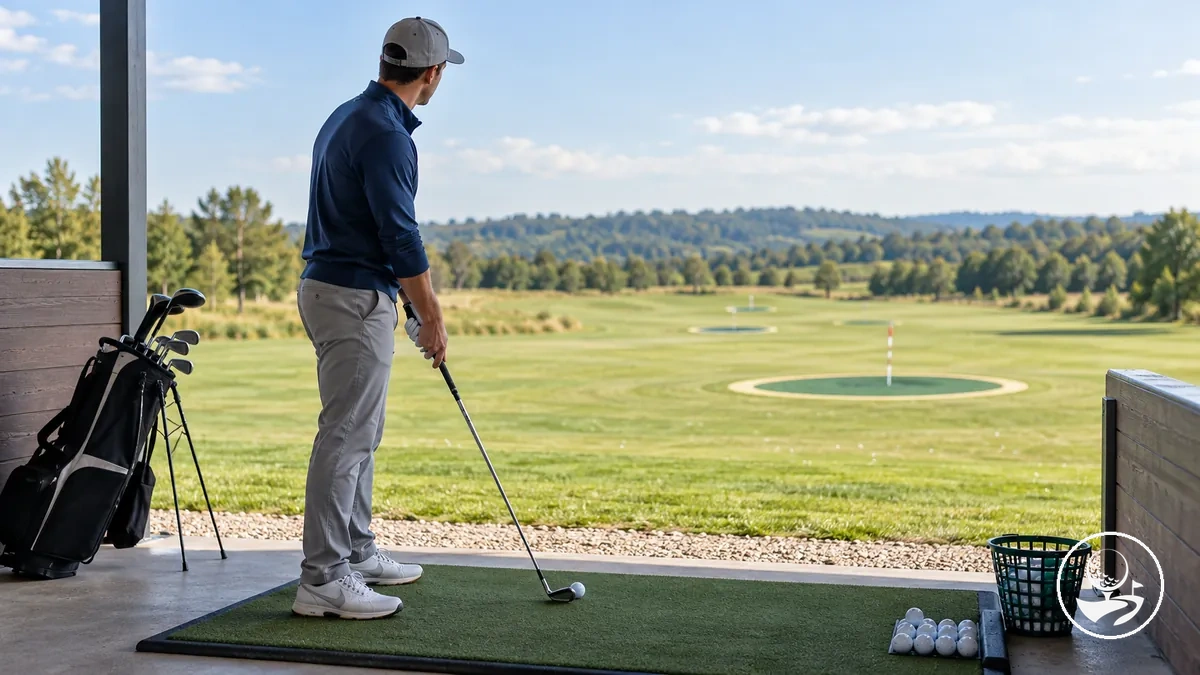
Available time, current skill and energy constrain the session plan.
With limited time or attention, a beginner golfer can narrow the chosen skill and keep the starting intensity manageable instead of adding more tasks.
With more available time and sustained focus, the session can progress further while remaining centred on the same practice objective.
If fatigue reduces attention, simplifying the remaining work keeps the plan aligned with its original purpose.
The club set and ball allocation should also match the chosen skill rather than being decided independently.
Select clubs that allow the intended task to be practised without unnecessary switching, then allocate range balls so the main practice priority receives deliberate attention instead of treating the bucket as something to finish.
This four-part check verifies whether goal, time, clubs and ball allocation support the same session focus:
- Goal: Define one chosen skill or practice objective for the range session.
- Time: Keep the planned work within the available time and attention.
- Clubs: Select a club set that supports the chosen skill and manageable starting intensity.
- Ball allocation: Allocate balls to the planned task rather than making ball quantity the purpose of the session.
For example, a beginner who wants to work on more consistent contact can arrive with that single goal, select familiar clubs that suit the task and reserve the available balls for purposeful repetitions.
Arriving without a session goal makes it easier to switch tasks or clubs without a clear criterion for what to observe.
Focused preparation should leave the beginner knowing exactly what the first practice task is before swinging.
Warm Up Before Full Swings
Begin the driving-range warm-up with easy movement and shorter swings, then increase swing length and effort gradually before attempting full swings.
Early swings should be used to check readiness rather than test distance or performance.
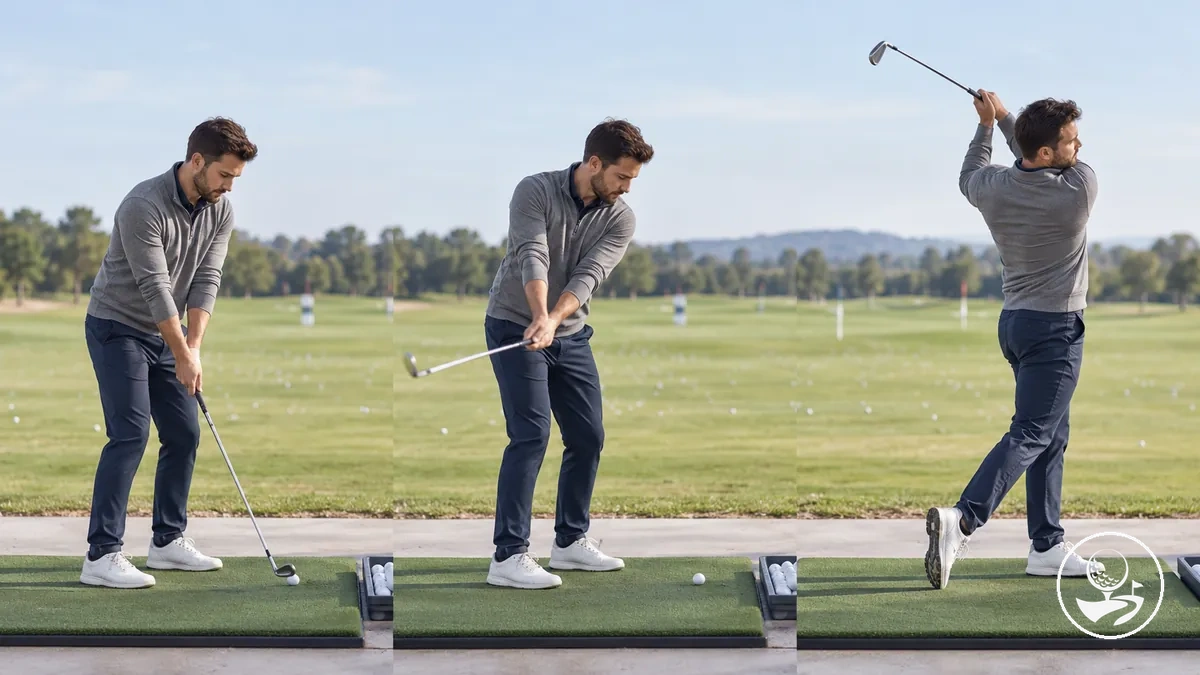
The warm-up sequence should increase movement and swing demand in stages rather than follow a fixed shot count.
Progress from movement preparation to controlled short-club swings and then toward fuller swings as readiness increases.
- Prepare movement: Begin with comfortable movement to assess physical readiness before increasing swing demand.
- Make easy short-club swings: Use a wedge or another short club with reduced effort and a shorter swing length.
- Progress through partial swings: Increase swing length gradually while keeping the movement controlled.
- Check readiness for fuller swings: Increase effort toward fuller swings only when the golfer feels ready to continue the progression.
The length and pace of the warm-up can change with available time, mobility and physical readiness, so one swing count does not apply to every beginner.
The warm-up is complete when the golfer is ready to begin normal practice with fuller swings, not when a fixed number of shots has been reached.
Choose a Small Set of Clubs for the Session
Choose a small set of clubs that matches the session goal instead of cycling through the entire bag.
Limited club selection keeps the practice task consistent and reduces unnecessary switching, making feedback easier to compare from one shot to the next.
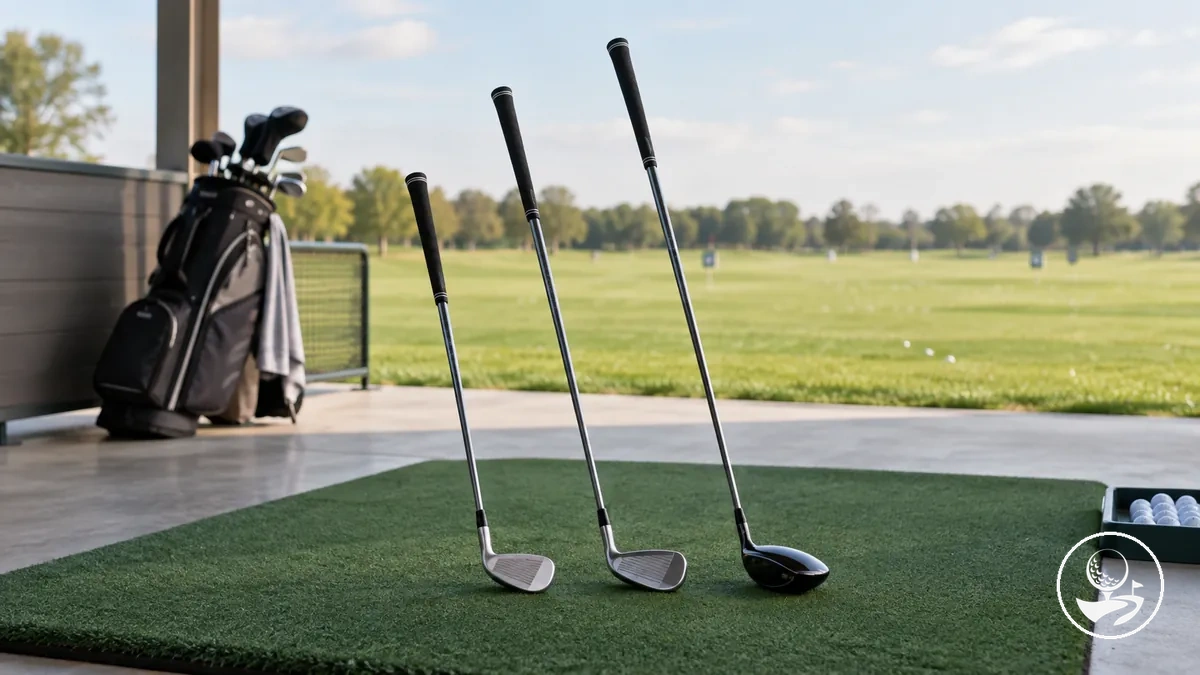
Club selection should reflect the intended practice task, the golfer's familiarity with each club and the difficulty created by relative club length.
A familiar club can make it easier to concentrate on the chosen skill, while a less familiar or longer club may increase the demands of the task.
These three criteria keep the selected clubs connected to the purpose of the session:
- Task fit: Choose clubs that allow the chosen practice task to be repeated and observed clearly.
- Familiarity: Include clubs the beginner can use without making club handling itself the main challenge.
- Progression difficulty: Add a more demanding club only when it suits the session objective rather than simply to use more of the bag.
For example, a wedge, a mid-iron and one longer club can form an illustrative club set when those clubs support the session goal.
That combination is not mandatory; the useful set depends on the beginner's familiarity, current skill and intended practice task.
Set a Ball Count That Preserves Focus
Choose a ball count that allows attention, recovery time and purposeful repetitions rather than chasing a fixed total of range balls.
The useful number is conditional on available time, fatigue, practice intensity and how the balls are allocated, so one universal numerical total does not apply to every beginner range session.
Organising range balls into practice blocks can make that allocation visible and support deliberate pacing.
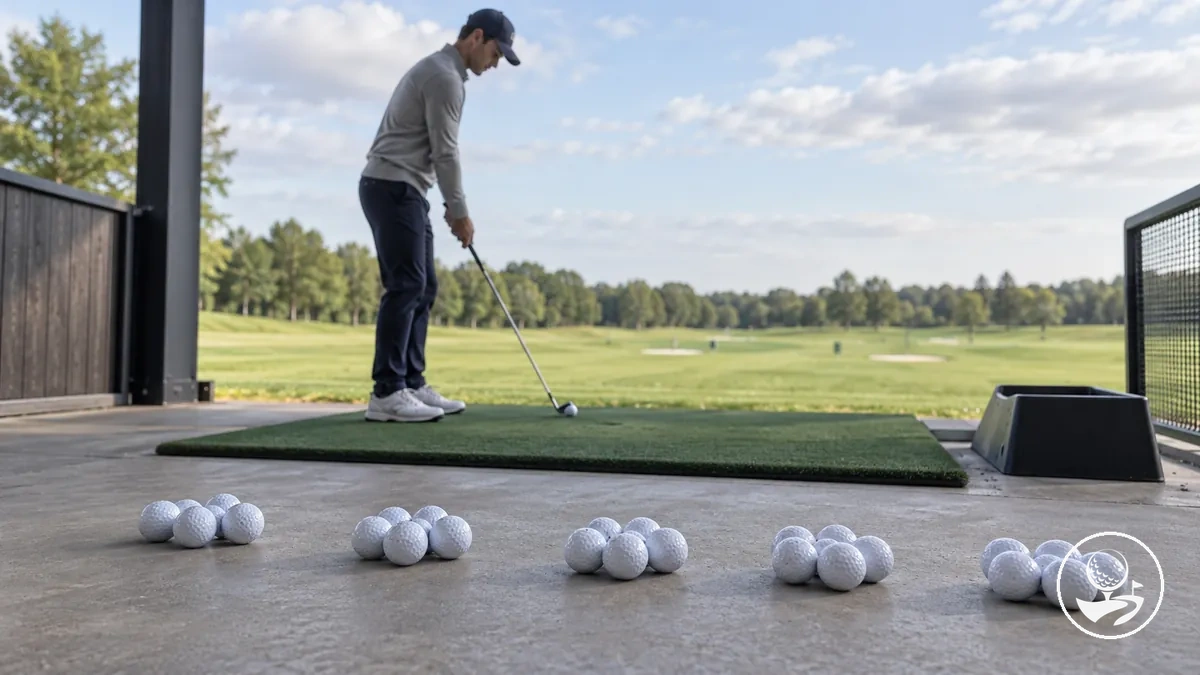
Available time, fatigue, practice intensity and ball allocation constrain how much focused work can be completed while attention and shot quality remain useful.
More available time can allow additional purposeful repetitions when attention is sustained, while increasing fatigue or a more demanding practice task can reduce the useful practice volume.
These four conditions help determine whether the planned ball count still supports focus:
- Available time: Allocate only as many range balls as can be practised without rushing the planned session.
- Fatigue: Reduce practice volume when tiredness begins to make sustained attention or controlled preparation harder.
- Practice intensity: A more demanding practice task can call for more recovery time between shots, reducing how many purposeful repetitions fit into the session.
- Practice blocks: Divide the ball allocation by purpose so each block has a defined task instead of treating the whole bucket as one undifferentiated volume.
A smaller purposeful allocation can leave more time to prepare, observe shot quality and reset between repetitions, whereas rapid hitting reduces that observation and recovery time.
Ball count should therefore remain subordinate to focus, pacing and the purpose of the range session.
Follow a Simple Beginner Range Routine
A beginner range routine should move from controlled shots toward greater club and target variation while keeping the same session goal.
Start with lower-demand work, then increase the challenge through selected clubs, defined targets and deliberate task changes.
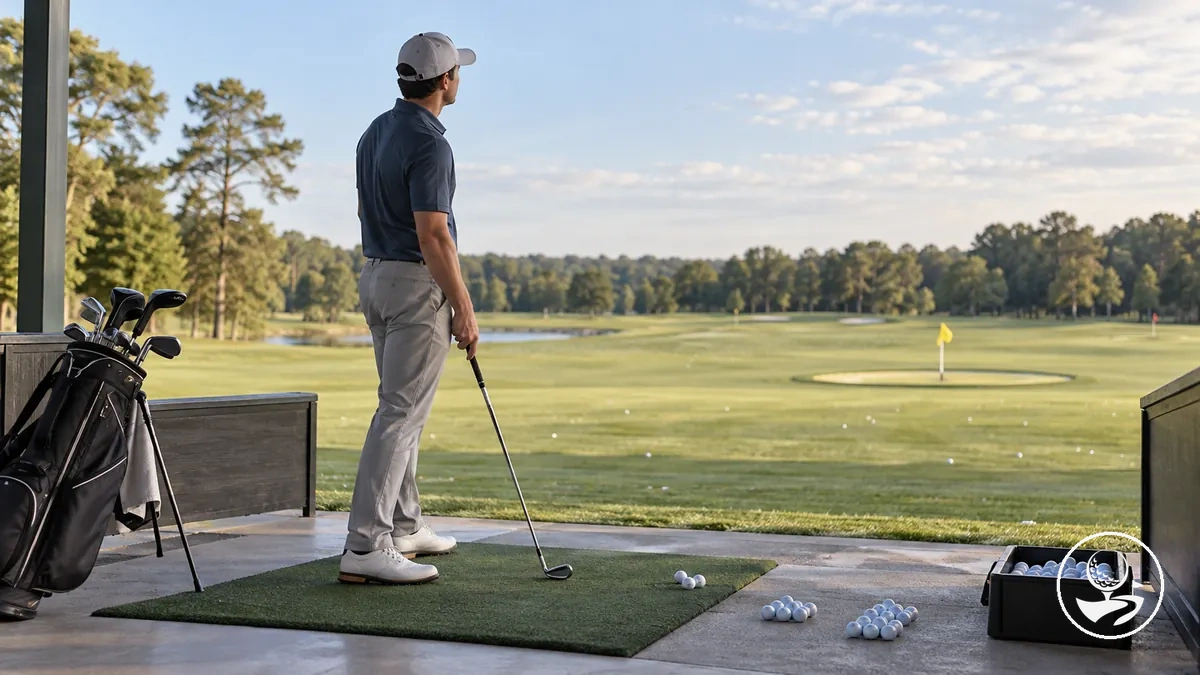
This session sequence keeps each practice block connected to the same objective while gradually increasing variation.
Use the steps as an adaptable progression rather than a fixed prescription for how long each stage must last.
- Start with controlled shots: Begin with a manageable practice task that lets you establish contact and settle into the session before adding more difficulty.
- Progress through selected clubs: Move through the clubs chosen for the session, increasing the demand only while the current practice block remains controlled.
- Aim at a defined target: Give each shot a clear target so direction and ball flight provide observable feedback rather than hitting without a reference.
- Pause and observe: Between shots, compare the result with the intended task and use that feedback to decide whether to repeat, adjust or continue the progression.
- Introduce variation: Change the club, target or practice task deliberately once the current block has served its purpose instead of repeating the same shot continuously.
- Finish when the work stops being purposeful: End the range routine when the session objective is complete or when declining focus makes further repetitions less useful.
A shorter range session can use fewer repetitions or fewer practice blocks while keeping the same progression from controlled work to greater variation.
With more time and sustained focus, individual blocks can be extended without changing the basic logic of the range routine.
Start With Short, Controlled Shots
Begin the practice phase with short, controlled shots so contact quality, tempo and the result relative to a target are easier to observe before difficulty increases.
Keep swing length and effort controlled so each shot provides clear feedback without turning the task into full-shot performance.
Progress From Shorter Clubs to Longer Clubs
Progress from shorter clubs to selected longer clubs only when the current task remains sufficiently controlled for the session goal.
Increasing club length and changing loft can increase shot demand, so progression should follow manageable contact quality rather than a rigid bag order.
Club progression should therefore adjust in both directions according to shot quality and purpose rather than requiring the full bag to be used.
Use Targets and Feedback to Make Each Practice Block Purposeful
Give every practice block a defined target and use a small set of observable feedback signals to evaluate each repetition.
The target provides a consistent reference for the intended shot, while contact, start direction and ball flight show what happened.
This makes the practice block easier to assess than hitting repeatedly into an open area without a clear intention.
Compare each shot with the intended target through simple observation rather than advanced measurement equipment.
Contact indicates how the strike felt or appeared, start direction shows where the ball initially travelled relative to the target, and ball flight shows how the shot continued after launch.
Use these observations together as practice feedback to guide adjustment rather than as a definitive swing diagnosis:
- Contact: Observe whether the strike is sufficiently controlled for the current practice task.
- Start direction: Compare the ball's initial direction with the intended target line.
- Ball flight: Observe the overall flight relative to the target and note whether the repeated result supports continuing or adjusting the task.
For example, aim several repetitions at the same target and compare the contact, start direction and ball flight after each shot.
If the observations become sufficiently consistent for the practice goal, continue the progression; if the results become less controlled, make an adjustment to the practice block or simplify the task before continuing.
Aim at a Specific Target Instead of the Open Range
Choose a specific target or target corridor before each shot so direction and outcome can be judged against an intended reference.
A defined aiming reference makes the practice task evaluable instead of treating the open range as the target.
For example, a beginner can first aim within a broad target area and then narrow the target corridor when the task remains manageable.
The underlying goal stays the same: aim at a defined reference and judge each shot by its outcome relative to that intended direction.
Review Contact, Start Direction and Ball Flight Against the Target
Evaluate each shot against the target using contact, start direction and ball flight instead of judging success only by total distance.
Each signal describes a different observable part of the shot, so using the same criteria across repetitions makes the observation more consistent.
Use the three signals together because an acceptable result on one criterion can coexist with a weaker result on another.
Treat each observation as feedback for the current practice task rather than as proof of a specific swing cause.
The practical implication is to repeat, adjust the task or move on according to the combined pattern of results:
- Contact: Observe whether strike quality is sufficiently controlled for the current task. If contact repeatedly deteriorates, repeat or simplify the task before progressing.
- Start direction: Compare the ball's initial direction with the intended target reference. If repeated shots start away from that reference, adjust the practice task or aiming setup before continuing.
- Ball flight: Observe how the shot develops relative to the target after its initial direction. Use that result with the other signals to decide whether to continue or adjust, without treating one flight pattern as a definitive diagnosis.
For example, solid contact with poor start direction shows that acceptable strike quality does not make the whole shot satisfactory, while poor contact with acceptable start direction shows the reverse.
Comparing both examples across all three criteria prevents one favourable signal from masking another part of the shot that still needs adjustment.
Use Block Practice Before Adding Random Practice
Block practice repeats a stable task, while random practice deliberately changes meaningful conditions such as the club or target.
Block practice keeps repetition and feedback centred on the same task, whereas random practice introduces greater task variability through club change, target change or both.
Neither practice method is universally suitable for every situation; the useful choice depends on the practice goal and how stable the current task is.
Block practice suits a beginner who needs repeated attempts at one clearly defined task, while random practice suits a later stage in the session when the golfer can maintain a clear intention as conditions vary.
The comparison below organizes repetition pattern, task variability, suitable use and the condition for progression.
It provides a practical basis for deciding when each method fits within the same range session.
| Criterion | Block practice | Random practice |
|---|---|---|
| Repetition pattern | Repeats the same or closely controlled task across successive shots. | Varies the task between shots or short groups of shots. |
| Task variability | Keeps club choice, target or another important condition relatively stable. | Introduces deliberate club change, target change or another meaningful variation. |
| Suitable use | Suits a defined practice goal when stable repetition helps the golfer observe the same task repeatedly. | Suits practice when the golfer can preserve a clear intention while meaningful conditions change. |
| Progression condition | Continue while the stable task still needs focused repetition or clearer feedback. | Add variability when the current task is sufficiently stable for the practice goal and intention remains clear. |
Progress from block practice to random practice when the current task remains sufficiently stable and the golfer can preserve a clear intention as variability increases.
If club change or target change makes the task difficult to evaluate or control, return to more stable repetition before increasing variability again.
Use Block Practice When Repeating One Skill
Block practice means repeating the same or very similar task long enough to work on one defined skill or pattern.
The repeated task stays purposeful by limiting what changes between shots and keeping the golfer's observation focused on the practice goal.
During a practice block, use the same club and same target while keeping the setup task consistent so each repetition can be compared under similar conditions.
Choose one limited feedback focus, such as contact or start direction, rather than trying to evaluate every possible result at once.
Continue the stable repetition while that observation remains useful, and change the task when the goal has been addressed or the repetitions stop providing clear feedback.
The example below shows constant task conditions rather than an exact prescription.
Add Random Practice When Changing Clubs and Targets
Random practice deliberately changes meaningful shot conditions after a stable practice pattern has been established, rather than creating unplanned variety.
A club change, target change or different shot task increases variability because the golfer must make a new decision before executing the next shot.
Reset before each changed shot
- Choose the club for the next intended shot rather than switching without a reason.
- Set a new target and shot task so there is a clear intention for that attempt.
- Hit, observe and compare the result with this shot’s reference, not the previous shot’s target.
Add only enough variability for the golfer to maintain a clear intention and useful observation; if those become unclear, reduce the number of changing conditions.
Random practice can increase task demands at the range, but it should not be treated as an automatic solution for range-to-course performance.
For example, a golfer could hit one shot with a mid-iron to a broad target, then make a club change to a shorter club and choose a different target, followed by another target change with a longer club.
Common Driving Range Practice Mistakes to Avoid
A driving-range practice mistake is any practice behaviour that reduces focus, weakens feedback or makes the current task unclear.
The main warning sign is that the golfer is still hitting balls but can no longer explain the intended target, the observation being made or the reason for the next repetition.
The most useful way to recognise these mistakes is to connect each behaviour with its consequence, recognition cue and correction.
The patterns below focus on practice-process errors rather than swing-fault diagnosis.
| Practice mistake | Consequence | Recognition cue | Correction |
|---|---|---|---|
| Hitting without a defined target | Direction becomes difficult to evaluate because each shot lacks an intended reference. | The golfer watches the ball finish but has no clear target result to compare with the original intention. | Choose a specific target or target area before the next shot and judge the result against that reference. |
| Rushing through excessive ball volume | Preparation and observation time can decrease, especially as fatigue or reduced attention affects shot quality. | Shots begin to follow one another with little pause to reset, observe or decide what the next repetition should achieve. | Reduce the pace or remaining ball volume and return to deliberate repetitions with time for feedback between shots. |
| Frequent club switching without a clear goal | Repeated task switching can obscure what skill or result is being practised. | The golfer changes clubs repeatedly but cannot state why the new club supports the current practice goal. | Limit club switching until each change has a defined purpose connected to the practice task. |
| Repeating shots without using feedback | Repetition becomes unfocused because the next shot is not informed by the previous result. | The golfer immediately hits again without reviewing contact, direction or another chosen observation. | Pause after each shot, use the selected feedback signal and make one task-level adjustment only when the observation justifies it. |
A recognition cue should prompt the golfer to restore a clear target, manageable task, useful feedback and deliberate focus before continuing.
When practice becomes rushed, directionless or difficult to evaluate, the correction is to simplify the task and make the next repetition purposeful.
Strong range performance can indicate that a practice task is going well, but it does not by itself establish course readiness or predict identical on-course performance.