
Golf Course Management for Beginners: Making Smarter Shot Decisions
Golf course management for beginners means choosing a realistic target, a club you hit reliably and a useful next-shot position according to the lie, hazards and your normal miss—not simply playing the longest shot. Allow for your likely miss before committing; an attacking line is worth considering only when its required distance, landing area and downside fit your reliable game.
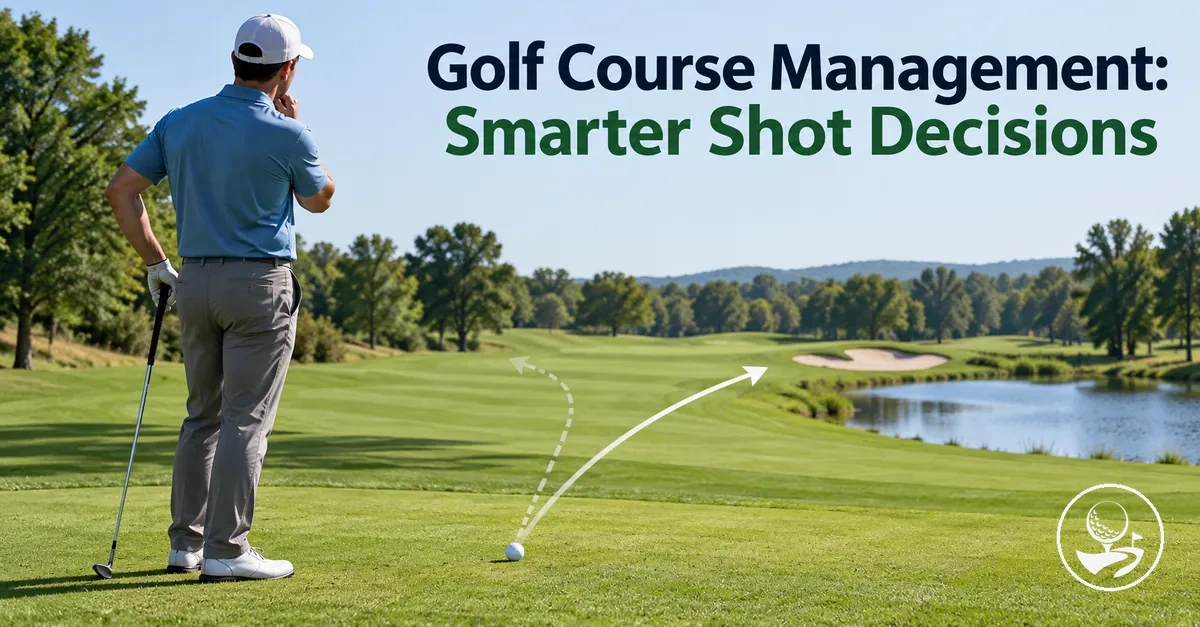
Choose a shot that fits the situation
Assess four practical conditions before deciding whether to attack, take a safer line or lay up. The result is a decision direction, not a prediction of where the ball will finish.
Suggested decision direction
Choose a safer line or lay up
Even with a clear route and reliable distance, serious trouble in the likely miss area weakens the case for an attacking line. Find more landing margin or leave a manageable next shot.
Reassess if the wind, lie, hazard position or your typical shot pattern changes. There is no universal club, aim point or score improvement that this guide can guarantee.
A useful decision accounts for both the intended result and the likely miss.
Course conditions such as the lie, wind, available landing area, and nearby hazard can change how much risk a particular target carries, while club choice should remain within the golfer's reliable ability.
The golfer's normal consistency also matters because a shot that requires unusually precise execution provides less margin than one that fits their reliable game.
Golf course management therefore considers not only where the current shot may finish, but whether the resulting next-shot position remains useful.
This playing strategy concerns deciding what shot to attempt, not changing the mechanics of the swing itself.
Smarter decisions can reduce exposure to avoidable trouble by matching the target and intended shot to the golfer's normal capabilities and the conditions in front of them, but they cannot guarantee a particular score.
Table of Contents
What Course Management Means for Beginner Shot Decisions
What the term means
- Playing strategy
- Choose a target or landing area, club and shot intention for the hole, your reliable ability and normal miss. The intended position should also leave a useful next shot; maximum distance is not the sole objective.
- Not the same thing
- This is shot selection, not swing execution. It does not mean maintaining a golf facility and is distinct from equipment catalogues or rules-and-etiquette guidance.
In practice, this playing strategy is visible before the swing when the golfer assesses the hole, identifies a target or landing area, and considers the club as one input to the decision.

The more useful choice can change with the lie, hazard position, wind, distance, and the golfer's own shot pattern.
A target that offers reasonable margin under one set of conditions may expose a likely miss to greater trouble under another.
Course management is therefore context-dependent decision-making: the golfer matches the shot intention to current conditions, reliable ability, and the position they want for the next shot.
Use a Simple Course-Management Decision Sequence Before Each Shot
A simple pre-shot course-management decision sequence helps a beginner process the same core inputs before committing to a shot.
Following a fixed order keeps raw distance from dominating the decision and gives equal attention to the landing area, trouble, normal miss, reliable distance, current conditions, and next-shot position.
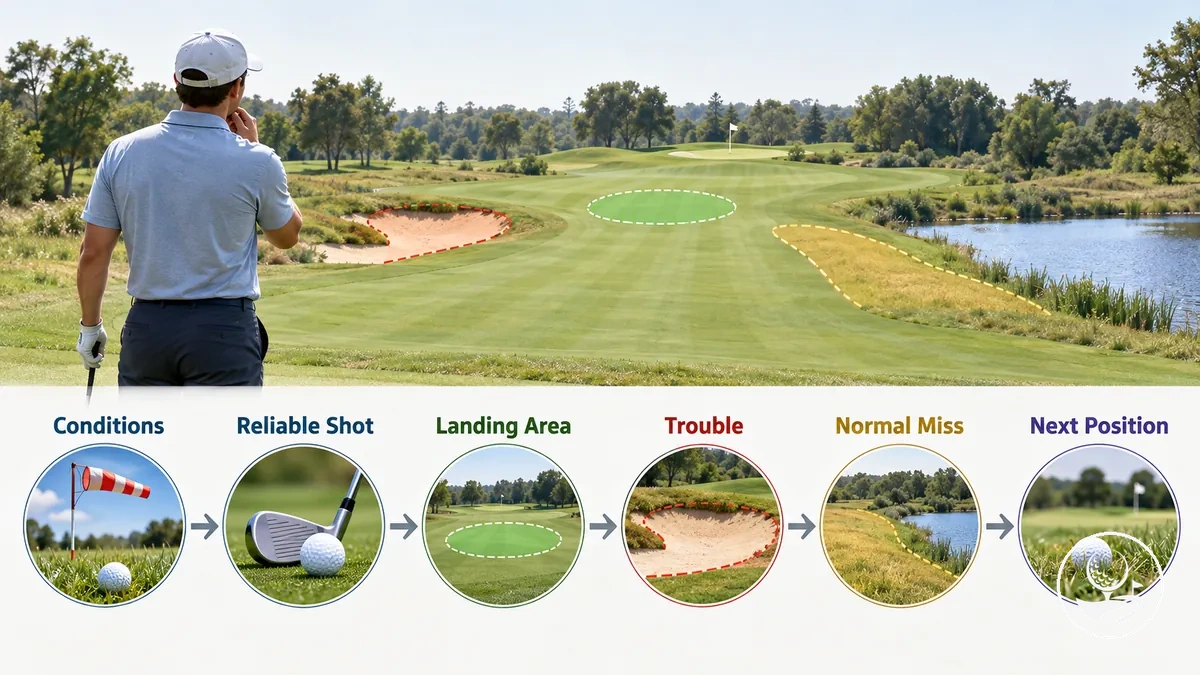
- Define a useful landing area. Identify where the ball should finish to leave a practical next shot rather than choosing a target only because it is farther away.
- Identify serious trouble. Note hazards, blocked areas, or other outcomes that would make a miss costly, and distinguish them from areas where a miss remains playable.
- Account for your normal miss. Consider the direction and size of the miss you commonly produce, then check whether that likely miss brings serious trouble into play.
- Choose a reliable club and shot. Match club choice to a reliable distance and shot intention you can produce consistently enough for the intended landing area, rather than relying on maximum possible distance.
- Check current conditions. Adjust the decision for factors such as lie, wind, elevation, and firmness when they materially change the expected landing area or reliable distance.
- Confirm the next-shot consequence and commit. Check whether the expected result, including a normal miss, still leaves a useful next-shot position; then commit to the chosen target and shot intention.
The same sequence can produce a different choice when the conditions change.
For example, a club that normally reaches a useful landing area may become less suitable if wind, lie, or nearby trouble makes the normal miss more costly, while a shorter option may leave a more manageable next-shot position.
The sequence does not guarantee an outcome; it organises the decision so the golfer can account for risk and usefulness before committing to the shot.
Choose a Target With Room for Your Normal Miss
A useful target provides enough margin for the golfer's normal miss while reducing exposure to the most costly trouble.
Target choice should reflect both the space available for the intended landing area and the consequence of the golfer's common miss, rather than rely on a universal aim point or precise aiming rule.
Out-of-bounds, penalty areas and blocked recovery lines usually make a miss more consequential than a playable finish in open ground. Judge the cost of the likely miss on this hole rather than treating every off-target result as equally risky.
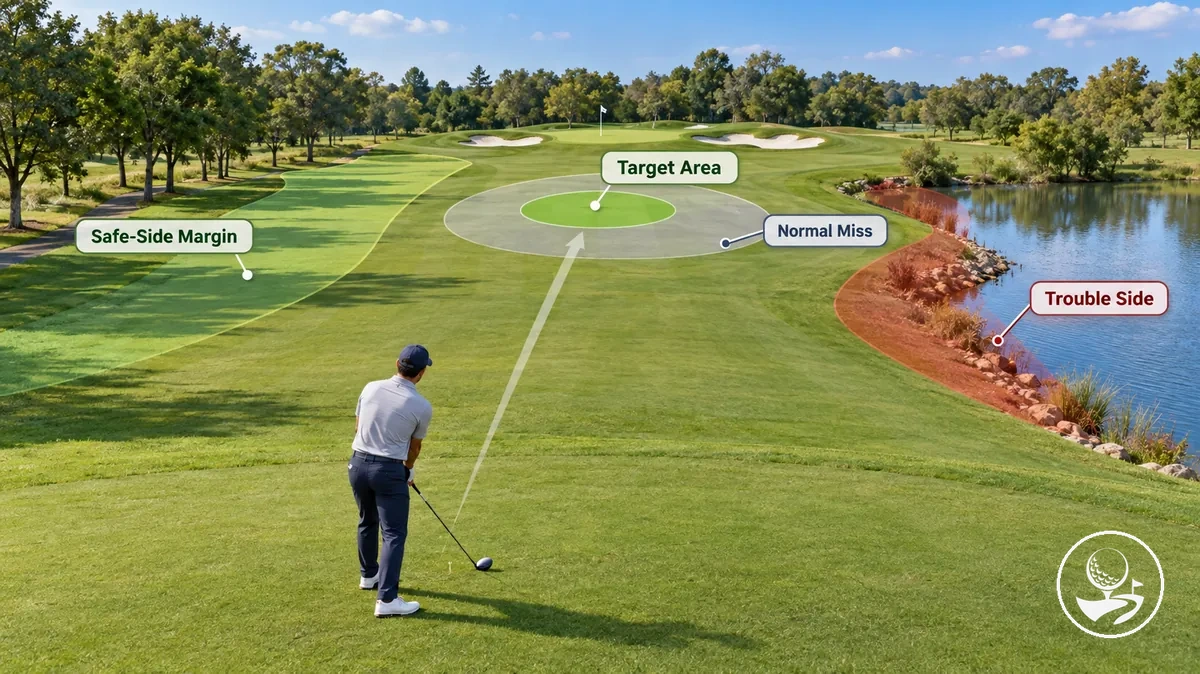
- Target width: A wider target area provides more usable space for normal dispersion than a narrow landing area.
- Trouble location: A hazard or difficult recovery area on one side increases the consequence of a miss in that direction.
- Safe-side space: More open ground away from serious trouble can provide greater margin when the intended shot does not finish exactly on target.
- Normal miss: The target should account for the direction and general spread of the golfer's common miss so the highest-cost outcome is less exposed.
- Current conditions: Lie and wind can change the expected landing area or dispersion, so the useful target may shift when those conditions materially affect the shot.
For example, a flag positioned close to a hazard may leave little margin on that side, while a larger target area farther from the hazard can leave more room for the same normal miss.
The strategic choice is the target that provides useful margin for the golfer's expected shot pattern, not the one that demands the most precise aim.
Choose a Reliable Club for the Shot You Need
Club choice should match a reliable club to the distance and landing outcome the golfer can produce with useful consistency, not automatically select the longest club available.
A reliable distance is the distance the golfer can reasonably expect from that club under the current shot conditions, with enough control to make the intended landing area practical.
When the shot must clear a hazard, compare the required carry with your reliable carry distance—the distance the ball normally travels through the air before landing, not its total distance including roll. If the usual carry leaves too little margin, look for a safer line or landing area.
The comparison is about the landing consequences of each option rather than equipment quality.
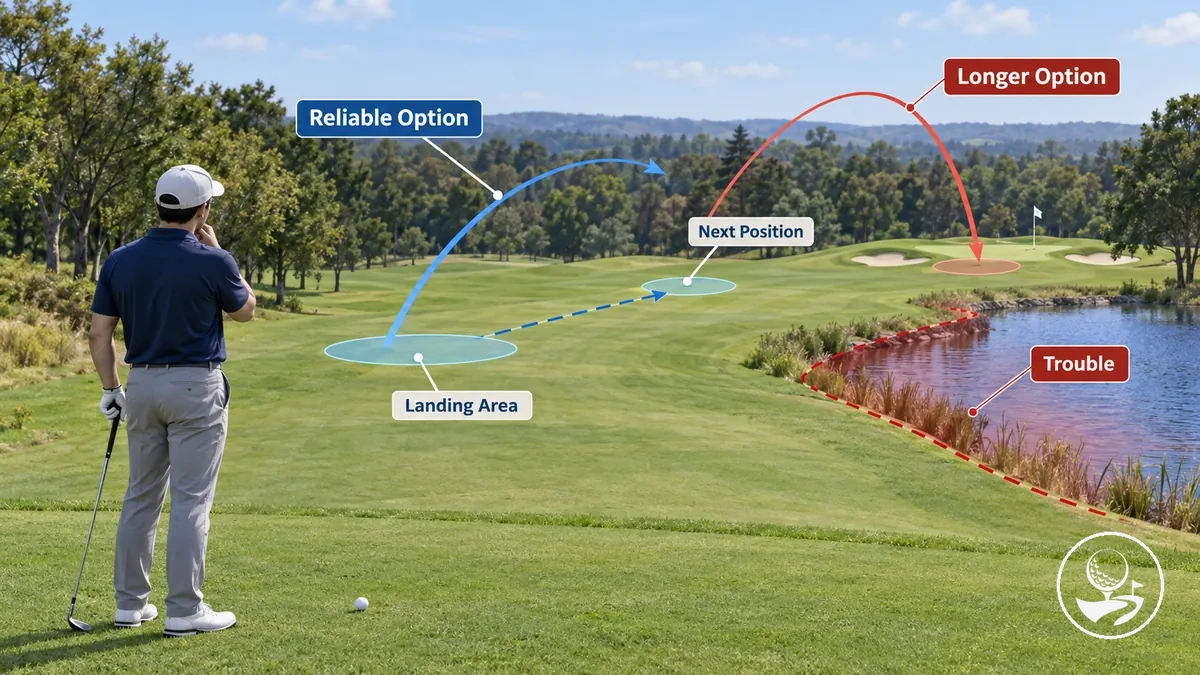
- Reliable distance: The club should cover the required shot with the golfer's normal consistency rather than depend on maximum possible distance.
- Lie and conditions: The lie, wind, and elevation can change how far and how predictably a club carries, so club choice should reflect the conditions of the current shot.
- Landing-area width: A controllable club can be more useful when its typical outcome fits the available landing area with greater margin.
- Hazard reach: Consider whether the club's expected shot can bring a hazard or other costly trouble into play, including through the golfer's likely variation.
- Next position: Prefer the club that can leave a useful next position when its reliable distance and landing outcome fit the shot requirement.
The useful club can therefore change even when the nominal distance to the target is similar, because lie, wind, available landing width, hazard reach, and consistency change the consequence of the shot.
Club function is useful background knowledge, but the current decision remains about how that club's reliable outcome fits the hole.
For example, when the longest available option brings a narrow landing area or nearby trouble into play, a shorter but more controllable club may leave a wider landing area and a more useful next position.
Plan the Next Shot Before You Commit
The value of the current shot depends partly on the next-shot position it creates.
A useful landing position should leave a manageable combination of remaining distance, angle, hazard exposure, and margin for error for the following shot.
Planning one shot ahead works backward from that useful next position before choosing the current shot.
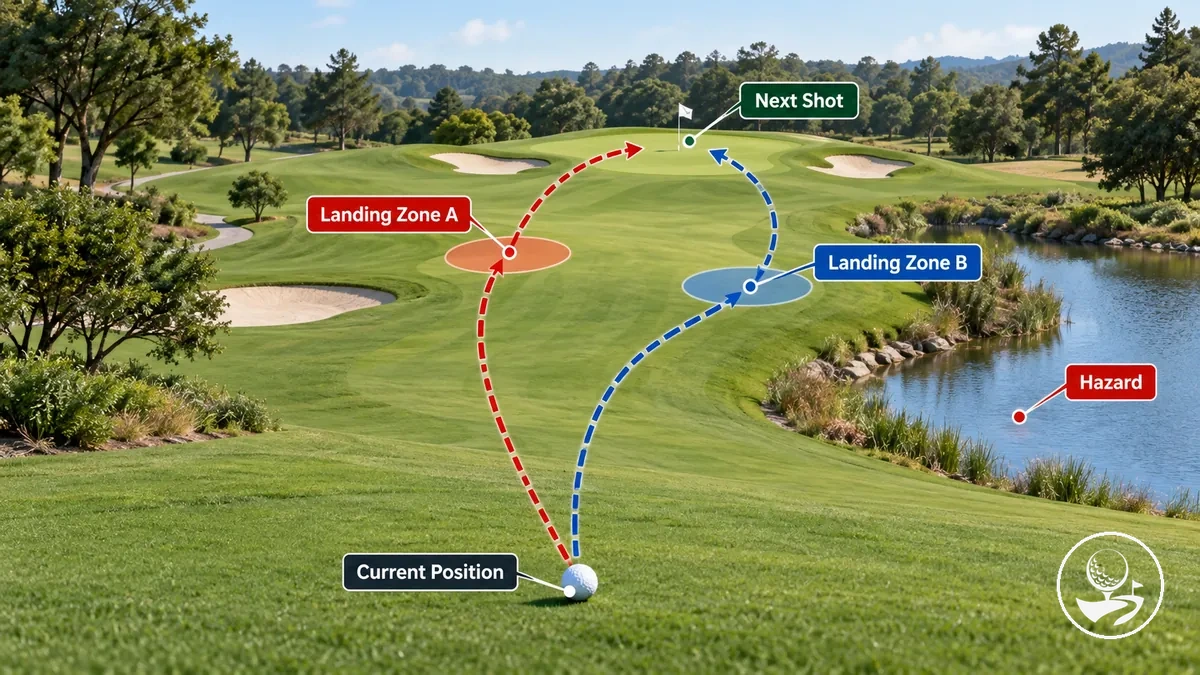
- Choose a useful landing zone. Identify a position that leaves enough space and margin for error without creating unnecessary hazard exposure.
- Check the next-shot distance and angle. Consider how the landing position changes the remaining distance, approach angle, and shot type required for the next shot.
- Select the current shot. Choose the shot that can reasonably create the more manageable position, rather than judging the decision only by how much distance it gains now.
For example, a tee shot or lay-up that travels a little shorter may leave a clearer angle and less hazard exposure for the next shot than a longer option that finishes in a tighter area.
Which position is preferable still depends on the golfer's ability, the lie, the remaining distance, and the available margin.
The planning goal is to leave a manageable next decision, not to maximize the current shot in isolation.
Base Course-Management Choices on Your Reliable Strengths
A reliable strength is a shot, club, comfortable distance, shot shape, or other pattern you can reproduce with enough consistency to plan around during play.
It should reflect repeated on-course performance rather than one exceptional shot or a best range result, because course-management decisions need a dependable baseline.
- Repeatability: The ability appears often enough across normal shots to support a decision rather than depending on an unusually good strike.
- Comfortable distance: A distance range you can handle with useful consistency can support more realistic club choice and landing-position decisions.
- Predictable shape or miss: A recurring shot shape or predictable miss can inform target choice and the margin you leave around trouble.
- On-course consistency: The reliable pattern should remain useful during actual play and relevant conditions; confidence alone does not establish a reliable strength.
Once a reliable strength is identified, it can change target choice, club choice, and risk.
A dependable pattern may support a target with more usable margin, while a less consistent shot may justify reducing exposure to trouble even when the more aggressive option is available.
The strategic value comes from matching the decision to the golfer's actual pattern rather than an idealized version of the game.
For example, a golfer who repeatedly produces a controllable shot to a comfortable distance can reasonably plan around that repeatable strength, even if an occasional best result travels farther.
The longer isolated result does not by itself establish a dependable strength; course-management choices should reflect the performance the golfer can reproduce on the course.
Favour Shots You Can Repeat Under Normal Conditions
A repeatable shot is more useful for course management than an occasional best shot because it is more dependable under normal conditions.
A reliable option is one the golfer can reproduce with enough on-course consistency to plan around, while a higher-variance shot may produce a better result occasionally but its greater variance makes it a less dependable basis for the same decision.
Which performance should guide the choice?
- Repeatable on-course option
- Check that the shot remains manageable for the lie, pressure, normal contact quality and comfortable distance. Under the same conditions, a shorter reliable shot may be a better planning choice than a longer, high-variance option.
- Best result from the range
- A strong range shot can inform expectations, but on-course conditions and decisions differ. One exceptional strike is not a dependable playing distance without repeated, relevant results.
Course-management choices should therefore reflect the shot the golfer can reasonably reproduce on the course rather than treating a best range result as guaranteed consistency.
Account for Your Usual Shot Shape and Miss Pattern
A recurring shot shape or miss pattern can justify shifting the target centre or leaving more directional margin toward the safe side, while an isolated miss should not drive the decision.
The useful planning input is an observed directional miss that occurs often enough to suggest where the likely miss area may be, not a guaranteed prediction of where the next shot will finish.
Match the target to your usual miss
- If the common miss moves towards trouble
- Shift the intended target centre away from that side, or leave more margin towards the safer area, when the available landing space allows it.
- If the common miss moves away from trouble
- Less directional adjustment may be needed, but keep a suitable landing margin rather than assuming every shot will follow the same shape.
The appropriate target shift therefore depends on the relationship between the shot shape, the likely miss area, the hazard position, and the available safe side.
A recurring pattern can inform the decision, but an occasional directional miss should remain an isolated result rather than a strategic rule.
Balance Risk and Reward When Deciding to Attack or Lay Up
A risk-reward decision weighs the potential gain from an aggressive shot against the cost and likelihood of the likely miss for this golfer in the current situation.
Risk increases when the miss can reach severe trouble or leave a poor next position, while reward increases when the shot can create a meaningfully better position.
Neither attacking nor laying up is automatically the better choice.
The decision depends on how the available landing area fits the golfer's reliable shot, the severity of nearby trouble, the lie, the usual miss pattern, and the usefulness of the resulting next position.
A larger potential gain strengthens the case for attacking only when the shot remains reasonably compatible with those conditions; a costly likely miss weakens that case.
The same criteria can instead support a lay up or a safer line when protecting the next position has more practical value.
- Attack: Consider the aggressive option when the potential gain is useful, the landing area fits a reliable shot, and the likely miss does not expose the golfer to disproportionate trouble.
- Lay up: Consider laying up when trouble severity or miss cost is high and a shorter shot can leave a more useful next position.
- Choose a safer line: When useful distance can still be gained without challenging the highest-cost trouble, a safer target line may balance risk and reward better than either maximum aggression or a full lay up.
- Reassess when conditions change: A difficult lie, reduced reliable distance, or a miss pattern directed toward trouble can weaken the case for attacking even when the hole itself has not changed.
For example, on the same hole, a clean lie with a broad landing area and a reliable shot that can reach a useful position may support an attack.
If the ball instead lies poorly and the golfer's likely miss brings a hazard into play, laying up or choosing a safer line may leave the more manageable next position.
The preferred choice therefore changes with the golfer and the conditions rather than following a universal attack-or-lay-up threshold.
Attack Only When the Potential Gain Fits Your Likely Shot
An attack is reasonable only when the shot demand fits the golfer's likely shot and the downside of a miss remains acceptable for the potential gain.
As the landing window narrows or the consequence of a miss increases, the case for the aggressive option weakens unless the golfer's current shot pattern can reliably meet that demand.
- Target size: A larger usable landing area supports the attack decision when the potential gain is meaningful, while a narrow target makes the same gain harder to justify.
- Trouble severity: Severe trouble near the likely miss area weakens the case for attacking because the downside of an imperfect result becomes more consequential.
- Lie: A favourable lie may support an attacking line when it allows the golfer to attempt the required shot normally, while a difficult lie can reduce the fit between the shot demand and the likely outcome.
- Reliable distance: The attacking option is more reasonable when the required carry or landing position falls within the golfer's reliable distance rather than depending on an exceptional strike.
- Miss tolerance: Greater margin around the target strengthens the case for attacking, while limited room for the golfer's normal miss weakens it even when the potential gain is attractive.
For example, an approach from a favourable lie to a broad safe area may support an attack when the required shot fits the golfer's reliable distance and usual pattern.
If the same potential gain requires carrying serious trouble into a tight landing window, the decision becomes less favourable because miss tolerance is lower.
The useful test is whether the attacking option fits the golfer's likely shot and current conditions, not whether aggression is available.
Lay Up to a Distance and Position You Can Use
To lay up is to choose a landing position that avoids unnecessary trouble and leaves a next-shot distance the golfer can use, not merely to hit the ball shorter.
The useful lay-up position depends on the current distance and lie, the golfer's reliable distance, available club distance, and the area that will leave a manageable next shot.
- Identify the trouble to avoid. Define the hazard, blocked area, or other consequence that makes the longer option less useful from the current position.
- Choose a reachable landing position. Select a safe area that fits a reliable distance with an available club rather than aiming for an arbitrary lay-up number.
- Verify the next-shot requirement. Check whether the resulting next-shot distance and angle leave a usable position for the golfer's own game.
For example, on a par 5 where the green is not a practical target from the current lie, a golfer may lay up to a landing area that avoids nearby trouble and leaves a comfortable remaining shot.
A farther lay-up is not automatically more useful if it produces an awkward next-shot distance, while a shorter positioning shot may leave a distance the golfer handles more reliably.
The preferred landing position therefore depends on the golfer's own club distances, the hole, and the conditions rather than a fixed universal distance.
Recover Position Before Chasing Distance From Trouble
When a shot finishes in trouble, the recovery priority usually shifts from maximizing distance to restoring a playable position when the aggressive route carries a high cost of failure.
The current lie, any obstruction, and the available escape line indicate whether a reliable recovery toward a safe landing area is possible or whether chasing distance would expose the golfer to disproportionate downside.
Two recovery routes
- If the lie is workable and the exit is clear
- A recovery can gain useful distance when the route and landing area still allow a playable next position.
- If the lie is poor or the route is blocked
- When penalty risk or the cost of failure is high, a shorter safe exit can restore a playable position with less downside.
The preferred recovery therefore depends on the feasible escape options and the quality of the resulting position rather than on recovering all lost distance at once.
For example, forcing an aggressive route through a narrow opening can compound the original mistake if a miss leaves the ball in deeper trouble instead of the available safe landing area.
Course-Management Mistakes That Add Avoidable Strokes
A bad swing is not always a bad decision
- Shot-execution error
- A shot can finish somewhere unintended even after a sensible decision. An imperfect strike alone does not prove a course-management mistake.
- Course-management error
- Choosing a target, club, recovery route or next-shot position that needlessly increases trouble or leaves a harder follow-up is a decision error. Its cost depends on the hole and actual result.
Each mistake can be recognized through the decision cue that preceded it and the consequence it created, then can be corrected by a practical corrective direction suited to that decision.
That correction may involve changing the target, choosing a more suitable club, selecting a more realistic recovery choice, or leaving a more manageable next-shot position.
Repeating the same decision error can compound difficulty because one poor course-management choice may create another demanding decision immediately afterward.
The common consequence is repeated exposure to avoidable trouble rather than a guaranteed number of strokes lost.
Aiming at Every Flag Instead of a Safer Target
Aiming directly at every flag can reduce useful margin when the pin position sits close to trouble or when the golfer's normal miss can bring a hazard into play.
In those conditions, the flag line may create a smaller practical landing area than a safer target that uses more of the available green or landing area.
For example, if a flag is positioned near trouble on one side while a wider target area remains available away from it, the same normal miss may carry more consequence on the direct flag line than toward the larger safer target.
The preferred target still depends on the pin position, surrounding trouble, hole shape, available landing width, and the golfer's miss pattern, so the middle of the green is not automatically correct.
The corrective direction is to choose the target area that preserves useful margin while still advancing the hole strategy.
Choosing a Club for Maximum Distance Instead of a Reliable Outcome
Choosing a club for maximum distance can be a course-management mistake when the extra length increases dispersion, extends hazard reach, or narrows the usable landing width.
A reliable outcome may come from a club choice that gains less distance but produces a more controllable landing result and a more useful next position.
Maximum distance alone is therefore an incomplete criterion when it increases risk without creating a better position.
Compare where the ball is likely to finish
- Maximum-distance choice
- May reach farther, but greater dispersion or hazard reach can reduce usable landing width and make the next shot harder.
- Reliable-position choice
- May finish shorter, yet fit a wider landing area with a more controllable result and clearer next shot. Compare the landing consequences, not the overall quality of the clubs.
The preferable option depends on the golfer's reliable distance, expected dispersion, hazard reach, available landing width, and the consequence of the resulting position.
The corrective principle is to make club choice serve the desired position and acceptable risk rather than maximum distance alone.
Trying to Recover Too Much After a Poor Shot
After a poor shot, the mistake is trying to erase the lost distance with a recovery that requires unusually high shot difficulty and carries a large downside if it fails.
When that recovery sits outside the golfer's reliable options, the attempt can turn the original mistake into a compounded error and leave an even less playable position.
The current lie and any obstruction determine how realistic the aggressive route is, while an available safe exit provides a lower-demand alternative.
If the recovery requires a shot the golfer does not normally produce and failure would create substantially more trouble, that recognition cue supports damage limitation rather than chasing all the lost distance at once.
A conservative recovery may therefore be justified when it can restore a playable position with lower downside, but an aggressive recovery can still be reasonable when the route is clear and the required shot fits the golfer's reliable game.