
Golf Club Types and Uses for Beginners
Golf clubs have five main functional types: woods (including drivers and fairway woods) for long shots, irons for controlled full shots and approaches, hybrids for longer shots that may replace some long irons, wedges for lofted short shots, and putters for rolling the ball on the green. Choose by shot objective, ball lie and required flight rather than assuming a club number guarantees a particular distance.
Quick shot-to-club guide
Start with the shot, not the club number
Use the situation to narrow the club types, then check the conditions that could change the choice.
- Long tee shotDriverUsually the distance-focused option from a tee. A fairway wood or iron may suit a tighter landing area or stronger control priority.
- Long shot, clean fairwayFairway wood · Hybrid · IronCompare the required carry, launch and the club you strike most consistently from the ground.
- Longer shot, light roughHybrid · IronConsider these when the ball sits well enough for clean contact; thick or uneven grass may limit the available options.
- Short shot near the greenWedge · Short ironA wedge can add height and carry; a short iron can suit a lower-running shot when the path to the green is clear.
- Ball on the greenPutterDesigned for direction and pace through controlled roll; sometimes useful from a smooth fringe too.
Final check: The lie (how the ball sits), landing area, hazards, wind, desired carry and roll, and your strike quality can all change the sensible choice. These are starting points, not guaranteed outcomes.
Different club designs influence launch, control and ground interaction, but their typical roles overlap and actual ball flight depends on the golfer, club specifications, strike quality and conditions.
Table of Contents
The Main Golf Club Types and What Each Is Used For
These five functional club families are a guide to shot purpose, not fixed distance brackets. Individual clubs in a family differ in loft and design, so the same category can serve more than one situation.
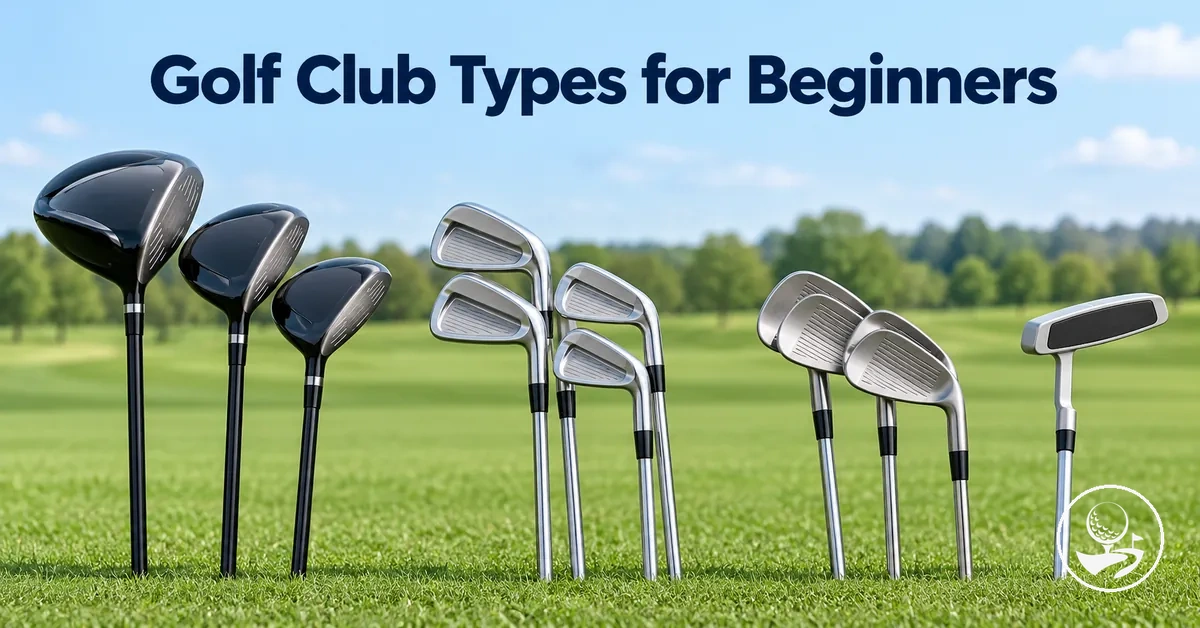
The illustration shows the distinguishing club shapes; the table below pairs each category's design tendency with its typical role.

| Club type | Key design tendency | Typical role |
|---|---|---|
| Woods | Larger heads and longer shafts, generally built for speed and lower-lofted ball flight | Long shots from the tee or suitable fairway lies |
| Irons | Numbered clubs with changing loft and shaft length through the set | Controlled full shots and approaches |
| Hybrids | Combine wood-like head characteristics with an iron-style playing role | Longer shots and an alternative to some long irons from varied lies |
| Wedges | Higher-lofted designs intended to produce shorter, higher shots | Short shots around the green and other situations requiring loft and control |
| Putters | Low-lofted faces designed primarily to start the ball rolling | Controlling direction and pace on the green |
The five functional categories are not the same as the number of individual clubs a golfer may carry.
Their uses can overlap depending on the lie, club specifications, and the golfer, so the categories are most useful as a starting point for understanding shot purpose rather than as fixed rules.
Woods: Drivers and Fairway Woods for Long Shots
Woods are primarily used for long shots, but drivers and fairway woods suit different playing conditions. Despite the category name, modern wood-type clubs generally have metal or composite heads.
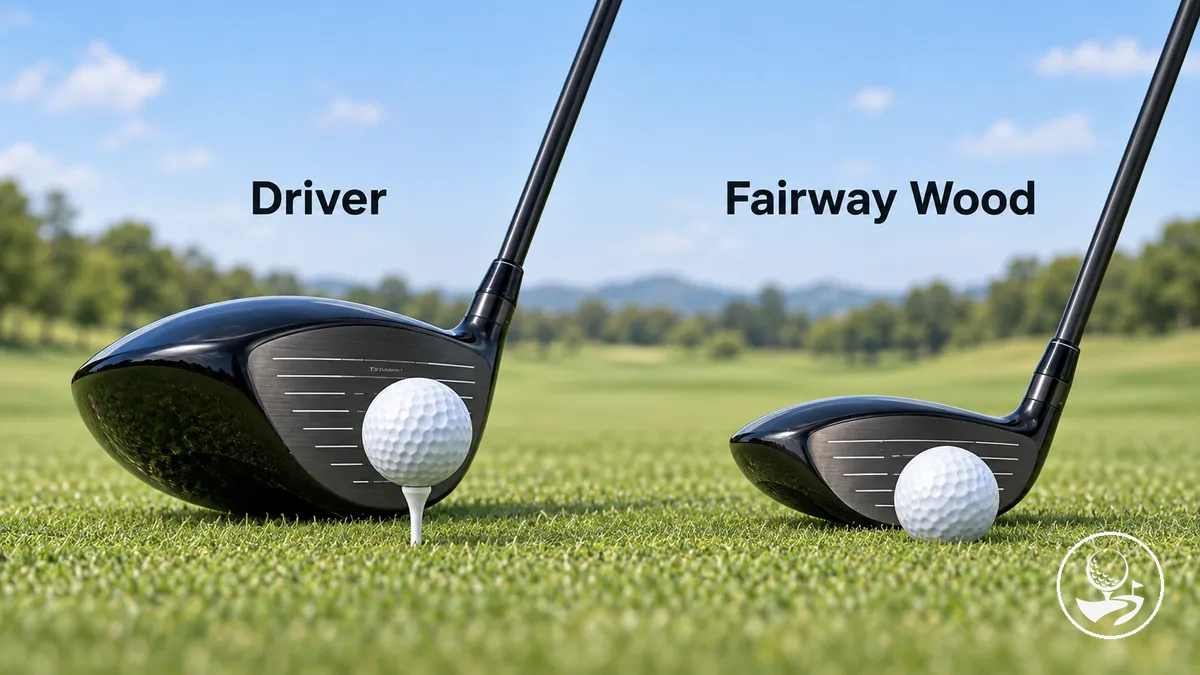
Driver
Typically the larger head, longer shaft and lower loft of the pair. Built primarily for a ball on a tee: the design supports speed and distance potential but may make control more demanding.
Fairway wood
Typically a smaller head, shorter shaft and more loft than a driver. Can be used from the tee or a suitable, clean ground lie for longer shots.
For example, a beginner might use a driver for a long tee shot and a fairway wood for a long shot from a clean fairway lie, showing their related but distinct roles.
Irons: Controlled Full Shots and Approaches
Irons are a numbered family of golf clubs used for controlled full shots and approaches.
Within an iron set, lower-numbered irons generally have lower loft and a longer-shot role, while higher-numbered irons generally have more loft and a shorter approach role.
The illustration shows this relative progression rather than a universal distance scale.
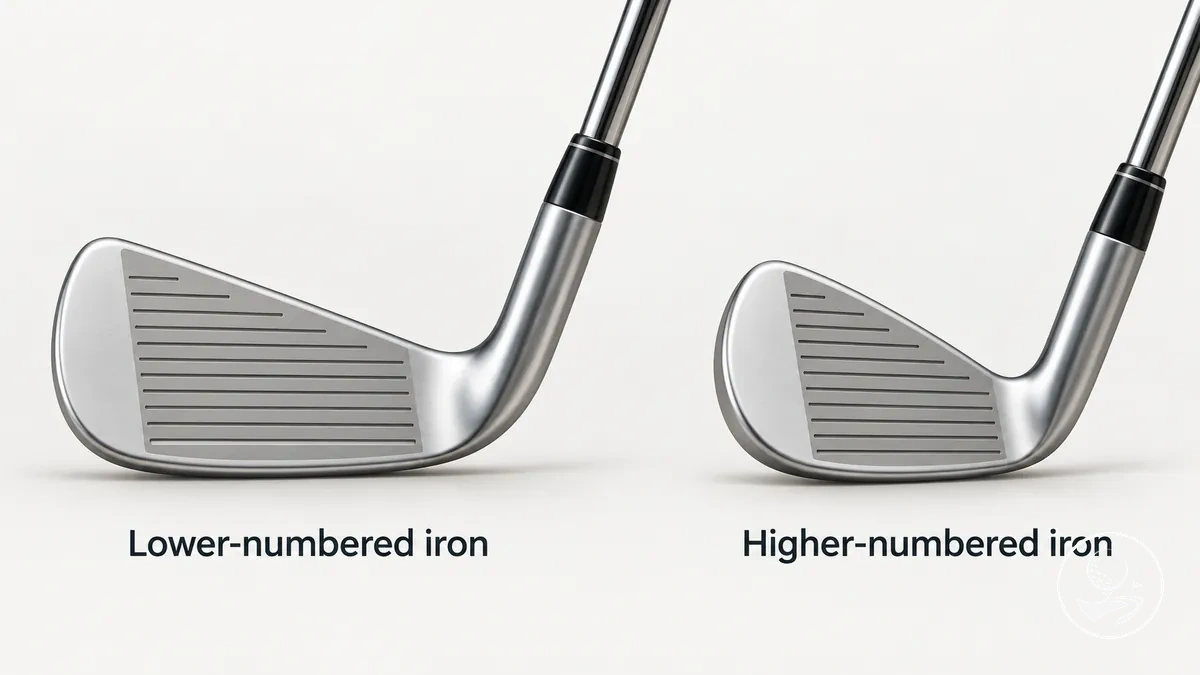
Club number, loft, shaft length, trajectory, and control work together to shape an iron's intended role: lower-numbered irons generally produce a lower trajectory and suit longer shots, while higher-numbered irons generally produce a higher trajectory for shorter approaches.
The same iron number can represent different lofts and specifications across models. Actual distance also depends on the golfer's swing delivery and strike, so compare clubs by their specifications and ball flight rather than by number alone.
For beginners, the numbering system is therefore most useful as a guide to relative shot roles rather than a fixed distance scale.
Hybrids: Longer Shots and an Alternative to Long Irons
Hybrids combine wood-like and iron-like design characteristics for longer-shot roles, including situations where a golfer may find a long iron demanding to launch or strike consistently.
Their clubhead form also makes the hybrid a distinct option for shots from the fairway or suitable light-rough lies.
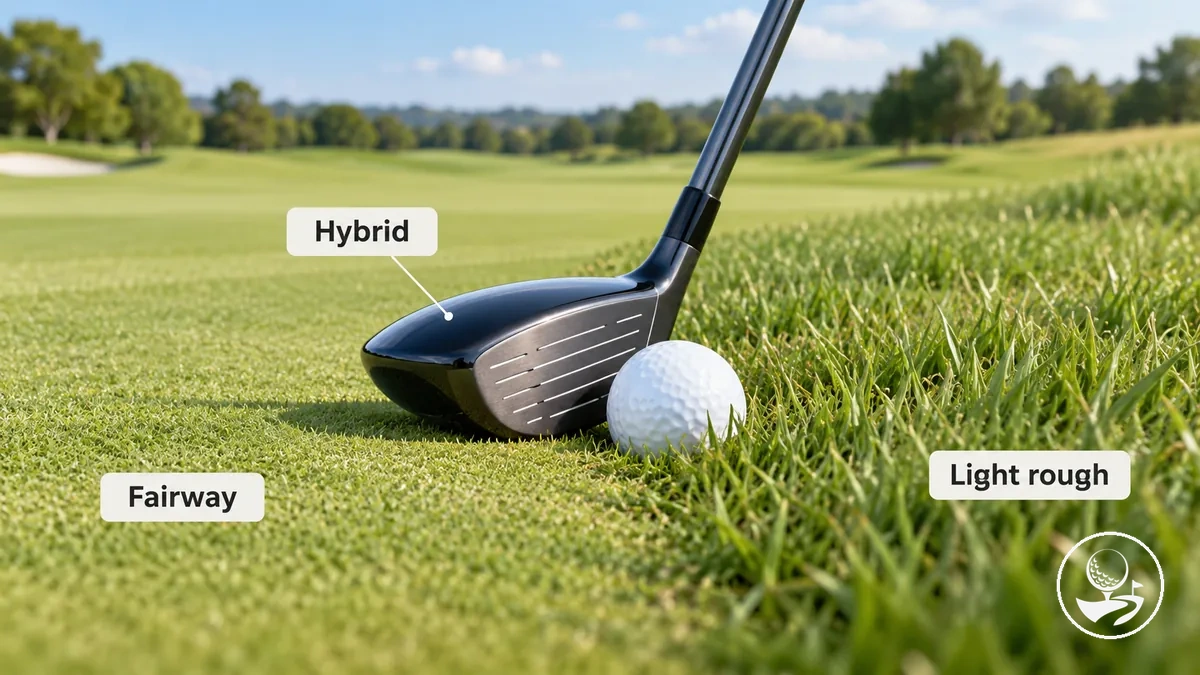
- Launch tendency: hybrid designs can support a higher launch than some long-iron setups, although ball flight depends on loft, model, strike, and golfer delivery.
- Forgiveness: hybrid head designs can offer more forgiveness on less-centred strikes than some long irons, but the result varies with club design and contact.
- Lie versatility: hybrids can be used for longer shots from the fairway and some rough lies when the ball is sitting suitably for the clubhead to reach it cleanly.
- Replacement role: a hybrid may fill the playing role of a long iron, but a same-number hybrid and iron are not automatically equivalent because loft, specifications, and resulting ball flight can differ.
For example, from a fairway or light-rough lie, a golfer may choose a hybrid when its launch characteristics and head design better suit the required longer shot than a particular long iron.
That does not make hybrids automatically better for every beginner or every lie; their replacement role depends on the hybrid's loft and model, the iron being compared, and the golfer's strike and delivery.
Wedges: Short, High-Lofted Shots Around the Green
Wedges are high-lofted clubs used for short shots where trajectory and short-game control matter more than maximum distance.
Common wedge labels include pitching wedge (PW), gap or approach wedge (GW/AW), sand wedge (SW), and lob wedge (LW). Loft and sole designs differ across models, so the label alone does not define one exact shot height or bunker performance.
Around the green, their loft and clubhead form support a range of approach, pitch, chip, and bunker roles, which the image illustrates in a typical short-game setting.
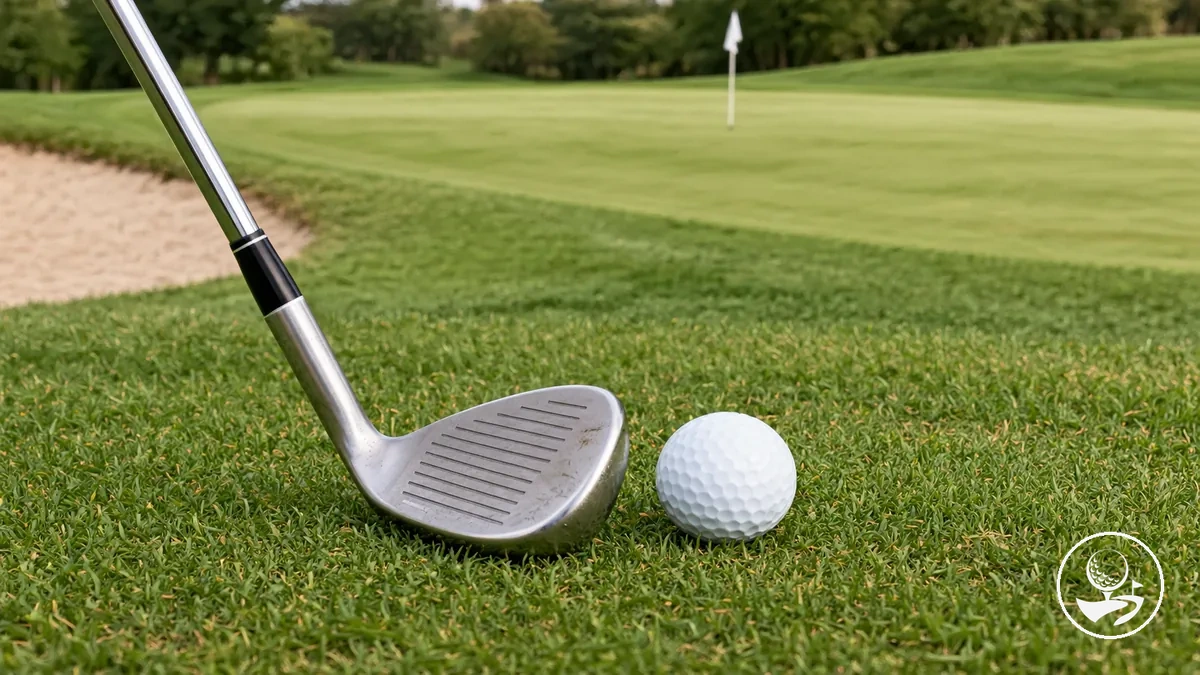
- Short approach: a wedge can be used when the intended shot needs a shorter carry and a higher trajectory into the green.
- Pitch: wedges suit short shots that need more height and carry before the ball reaches the green.
- Chip: a wedge can produce a relatively short carry with some roll, depending on loft, lie, strike, and shot choice.
- Bunker: wedge loft and sole interaction can help the club move through sand for an escape shot when the lie is suitable.
Loft influences ball flight, while sole interaction affects how a wedge meets turf or sand, so different lies can change which short-game role is practical.
A higher, shorter wedge shot may suit a situation that needs more trajectory, whereas a lower-running short-iron option may be more appropriate when less height and more roll are desired; neither choice guarantees a particular stopping result.
Putters: Rolling the Ball on the Green
A putter is designed primarily to start the ball rolling on the green while the golfer controls direction and pace.
Its low-lofted face and putting-surface role are intended to promote roll rather than the airborne carry produced by more lofted clubs.
A putter may also be used from some fringe positions when the ball can roll smoothly onto the putting surface, but its specialised role remains controlling the ball's roll on the green.
How Golf Club Design Changes a Club's Role
Golf club design shapes the typical role of each club through loft, shaft length and clubhead construction working together. No one characteristic guarantees a particular ball flight or result.
- Loft and club number
- Loft helps shape launch and trajectory. Numbers usually indicate relative loft and purpose within a club family, not a universal flight or distance.
- Shaft length
- A longer shaft can widen the swing arc and increase speed potential, while a shorter shaft often makes control easier. Both depend on the golfer's strike.
- Head shape, weighting and sole
- Head construction can change forgiveness on off-centre hits; shape and sole design can affect contact with turf, sand and rough.
A driver combines relatively low loft, a longer shaft and a large head for long tee shots; a wedge combines more loft, a shorter shaft and a short-game sole for a different task. Their performance is shaped by the full design and golfer delivery, not by loft alone.
Loft and Club Number Affect Launch and Intended Use
Loft is the clubface angle that helps influence launch and trajectory; delivery at impact also matters. A club number usually signals a relative role within its own family, not a standardised loft across every model.
Lower loft or a lower number generally corresponds to a lower-launching, longer-shot role, while higher loft or a higher number generally corresponds to a higher-launching, shorter-shot role.
The table shows these relative tendencies rather than fixed specifications or distances.
| Loft or number pattern | Typical launch tendency | Typical trajectory | Intended role |
|---|---|---|---|
| Lower loft or lower number within a club family | Lower launch tendency | Relatively lower ball flight | Longer-shot role |
| Higher loft or higher number within a club family | Higher launch tendency | Relatively higher ball flight | Shorter-shot role with more emphasis on control |
These relationships are not perfectly standardised because club specification varies across models and categories, and a same-number hybrid and iron are not necessarily equivalent.
Actual distance also depends on factors such as golfer speed, strike, and the club's specifications, so loft and club number are best treated as relative role signals rather than a complete beginner distance chart.
Club Length Affects Speed and Control
Club length involves a speed–control trade-off: longer shafts can provide more speed potential, but shorter shafts can be easier to control.
Longer shaft
Can create a wider swing arc and greater clubhead speed potential, as with a driver. Setup, centred contact and direction can be more demanding.
Shorter shaft
Often reduces speed potential but can support a different level of control, as with a wedge used for a shorter target.
Neither outcome is fixed: strike quality, loft, clubhead design, setup and technique affect both speed and control.
Clubhead Design Affects Forgiveness and Ground Interaction
Clubhead design includes size, shape, weighting and sole design. These attributes can influence launch, ground interaction and forgiveness—a club's tolerance of less-centred contact rather than a guarantee of accuracy.
These features can change contact tolerance and turf interaction, but their practical effect also depends on the complete club design and the golfer's delivery.
A larger or differently weighted clubhead can provide more forgiveness on some off-centre contact, while sole design and head shape can affect how the club moves through turf or rough, helping shape its practical role.
For example, a large wood-style head may support a different forgiveness and launch tendency from a wider-soled iron or hybrid, while the wider sole can change ground interaction; neither feature guarantees a particular result on its own.
Where Each Club Type Is Typically Used on the Course
Playing location alone does not determine the right club. The ball's lie and the shot objective are equally important.
A ball on the tee, fairway, rough, fringe or green may call for different clubs even at similar distances because the required trajectory and contact conditions differ.
- Location: the tee, fairway, rough, area around the green, and green each make different club categories relevant, but location does not create a fixed choice.
- Lie: how the ball sits can affect whether a driver, fairway wood, hybrid, iron, wedge, short iron, or putter can make suitable contact.
- Desired trajectory: the required height, carry, or roll can change whether a lower- or higher-trajectory club type better suits the situation.
- Shot objective: the intended landing area and desired result, such as advancing the ball, approaching the green, playing a short shot, or controlling roll and pace, help narrow the relevant club categories.
The lie can make a club suitable from one fairway or rough position but less suitable from another, while the available landing area can change how much carry or roll is useful.
Desired trajectory also matters when hazards, wind, or the required shot shape affect the intended ball flight.
The shot objective therefore connects the playing situation with the club's known role rather than assigning one club solely from location.
At a high level, longer-shot clubs are more relevant from the tee or suitable fairway lies, hybrids and irons can suit fairway or rough situations, wedges and short irons can serve shots around the green, and the putter is primarily used to roll the ball on the green.
These are conditional usage patterns rather than fixed selection rules, because lie, landing area, trajectory, hazards, wind, and shot objective can change which club is appropriate.
From the Tee: Drivers, Fairway Woods and Irons
From the tee, the shot requirement helps determine whether a driver, fairway wood, or iron suits the intended role.
A driver usually offers the greatest distance potential, while a fairway wood can provide a different balance of trajectory and control, and an iron may suit a shorter target or a stronger control priority.
For example, when the landing area is wide and the objective is to maximise distance potential, a driver may fit the tee shot; when the target is shorter or control matters more, a fairway wood or iron may better match the shot requirement.
These are conditional roles rather than fixed rules, because the appropriate club depends on the target, landing area, golfer ability, and playing conditions.
From the Fairway or Rough: Fairway Woods, Hybrids and Irons
A clean fairway lie usually gives a fairway wood, hybrid, or iron a clearer path to the ball, while thicker or uneven rough can make clean contact and launch more difficult.
As the lie changes, club suitability depends more on head design, forgiveness, control, and how easily the club can reach the ball through the grass.
- Clean fairway lie: a fairway wood, hybrid, or iron may all suit the shot when the ball is sitting cleanly, with the preferred option depending on the required launch, control, and intended role.
- Light rough: a hybrid can provide a useful middle ground between wood-like head characteristics and an iron-style role, while an iron may also suit the shot when the lie still allows reliable contact.
- More demanding rough: thicker or uneven grass can increase the contact challenge, so the practical value of a fairway wood, hybrid, or iron depends on how the clubhead interacts with the lie and how consistently the golfer can strike the ball.
For example, a fairway wood may suit a long shot from a clean fairway lie, while a similar target from rough may make a hybrid or iron more practical because the lie changes the contact and launch conditions.
Hybrids often bridge fairway-wood and iron roles, but their forgiveness and control are still influenced by the specific club design and golfer delivery.
No one category is universally superior from rough; the suitable choice remains conditional on lie depth, contact quality, launch requirement, and the golfer.
Around the Green: Wedges and Short Irons
Around the green, compare the lie, required height, available landing area and carry-versus-roll balance. Carry is travel through the air; roll is travel after landing.
Plenty of green to roll across
A short iron may suit a lower-running shot that lands sooner and rolls farther, provided the lie allows clean contact and the path is clear.
Obstacle or more carry needed
A wedge may suit a higher shot with more airborne carry from a suitable lie. Actual roll and stopping still depend on strike, lie, green conditions and intent.
On the Green: Putters
On the green, the putter is the normal club because its low-lofted design is intended to start the ball rolling along the putting surface while the golfer controls direction and pace.
Its role is therefore to manage roll rather than produce the airborne carry expected from more lofted clubs.
Wedges and short irons are more commonly used around the green when the shot needs some carry before the ball reaches the putting surface, while the putter remains the standard choice once the primary objective is controlled roll on the green.
Golf Club Types Beginners Commonly Confuse
Hybrids, long irons, and fairway woods can overlap in the kinds of longer shots they are used for, but that does not make the club categories interchangeable.
The categories are not interchangeable merely because their shot ranges overlap. Compare the same design and playing criteria rather than relying on the club's name or number.
- Loft: compare the actual loft rather than assuming clubs with similar labels or numbers will produce equivalent launch or shot roles.
- Shaft length: differences in shaft length can change speed potential and control, affecting the practical fit of otherwise similar club categories.
- Head design: head size, shape, weighting, and sole design can change how a hybrid, long iron, or fairway wood interacts with the ball and ground.
- Launch: compare the tendency to produce a higher or lower ball flight under similar conditions rather than assuming every golfer will launch a club the same way.
- Forgiveness: consider how the complete club design responds to less-centred contact, while recognising that golfer delivery and strike quality also influence the result.
- Lie suitability: a clean fairway lie, light rough, or more demanding lie can change whether the design characteristics of a fairway wood, hybrid, or long iron suit the shot.
- Control: compare how shaft length, head design, loft, and the required shot shape affect the golfer's ability to produce the intended result.
Using these criteria keeps the comparison focused on meaningful design and playing differences rather than category names alone.
Overlap in intended role does not mean identical specifications, launch, forgiveness, control, or performance.
The suitable club depends on the golfer, lie, required ball flight, and shot objective rather than on one category being universally better.
The detailed comparisons that follow apply the same criteria to each club pairing.
Hybrid vs Long Iron
A hybrid and a long iron can cover overlapping longer-shot roles, but their different designs can produce different launch, forgiveness, lie performance, and trajectory control.
The comparison is therefore about functional trade-offs and practical fit rather than identifying a universal winner, and the same club number does not guarantee the same loft or performance.
| Option | Launch tendency | Forgiveness tendency | Lie versatility | Trajectory control | Typical context |
|---|---|---|---|---|---|
| Hybrid | Often designed to support an easier or higher launch than a comparable long iron, depending on loft, head design, and golfer delivery | Can provide more forgiveness on imperfect contact because of its head design, although results vary by model and strike | Can suit clean fairway lies and some rough lies where the clubhead can reach the ball effectively | Often produces a different, generally higher flight profile, with control depending on specification and golfer delivery | May fill the replacement role of a long iron when its loft, launch characteristics, and lie suitability better match the required shot |
| Long iron | Typically requires sufficient strike quality and delivery to produce the intended launch, with the exact tendency depending on loft and design | May offer less tolerance on imperfect contact than some hybrid designs, although this varies with the specific iron and golfer | Can suit cleaner lies where the golfer can make reliable contact; thicker or uneven lies may increase the contact challenge | Can provide a lower or more penetrating trajectory profile for golfers who can control the strike and flight | May suit longer shots where its trajectory control and iron-style characteristics fit the golfer and lie |
These tendencies depend on the golfer, loft, club number, head design, shaft specification, and lie, so a hybrid should not be treated as an exact replacement for a same-number long iron.
For example, on a longer approach from light rough, a golfer may favour a hybrid when its launch and forgiveness characteristics better suit the lie, while another golfer may prefer a long iron from a clean lie when its trajectory control better matches the required shot.
Fairway Wood vs Hybrid
A fairway wood and a hybrid can both serve a long shot from suitable conditions, but they commonly differ in head size, shaft length, and lie versatility.
A fairway wood generally uses a larger head and longer shaft, while a hybrid uses a more compact, iron-like format that can change launch, control, and practical fit across different lies.
| Option | Head and shaft tendency | Launch profile | Lie versatility | Control tendency | Typical context |
|---|---|---|---|---|---|
| Fairway wood | Generally a larger head with a longer shaft than a comparable hybrid | Often designed for longer-shot launch from suitable lies, with exact flight depending on loft, model, strike, and golfer delivery | Well suited to a clean fairway or similarly favourable lie; thicker rough can make clean contact more demanding | The longer shaft and larger head can increase speed potential while placing different demands on control | Long shots from the fairway or tee when the lie supports clean contact and the required flight suits the club |
| Hybrid | Generally a smaller head and shorter shaft than a fairway wood, with a more iron-like playing profile | Often designed to support a playable launch from a wider range of lies, although the result depends on loft, head design, strike, and golfer delivery | Can suit clean fairway lies and some rough lies where its more compact head can reach the ball effectively | The shorter shaft and compact head can support a different balance of control and speed potential | Longer shots where lie versatility, launch, and control make the hybrid a practical fit |
Launch, control, and lie versatility remain dependent on the specific club and golfer, so neither category has a universal advantage in every condition.
From a clean fairway, a fairway wood may suit a longer-shot role when its launch and speed potential match the target, while from rough a hybrid may become more practical when its head size, shaft length, and contact characteristics better suit the lie.