
Putting Fundamentals for Beginners
For more consistent putting, build a comfortable, repeatable setup, aim the putter face square (perpendicular) to your chosen start line, and make a smooth stroke that returns the face predictably at impact. Start with the ball near the stance centre or slightly forward, then compare its initial direction across several putts. A putt can start on line and still miss because of pace or green break.
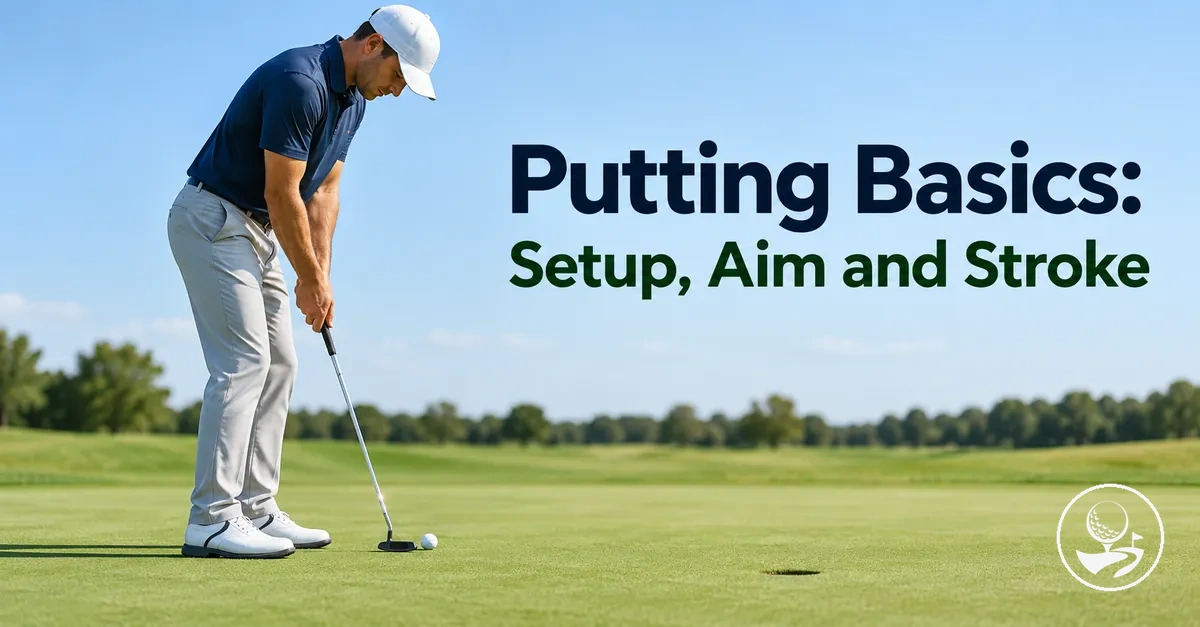
Four checkpoints for a repeatable putt
Follow the same sequence on each attempt. Each checkpoint has a reference to keep consistent and a result you can observe.
-
Build your setup
Use a comfortable grip and posture. Keep the ball around the stance centre to slightly forward, and repeat your chosen head and eye position.
Reference: the same address conditions
-
Choose and aim
Pick the intended starting direction. Set the putter face square to that line; a nearby spot on the line can help you aim.
Reference: face orientation, not foot position alone
-
Deliver the stroke
Move the shoulders and arms in a controlled rhythm. Aim for centred contact and predictable putter-face orientation through impact.
Reference: repeatable contact and face delivery
-
Check the ball's start
From the same spot and start line, notice whether repeated balls begin on line, favour one side, or vary from attempt to attempt.
Reference: initial direction, not just a made or missed putt
Use the result: If starts repeatedly favour one side, check face aim, delivery and strike quality. If they vary, return to a stable setup and rhythm. Change one variable at a time; a single putt does not establish the cause.
There is no single compulsory stance or stroke shape: a workable beginner technique is one that remains comfortable and repeatable. Use the sections below to refine each reference without changing everything at once.
Table of Contents
Build a Repeatable Putting Setup
A repeatable putting setup means beginning each putt from consistent body, ball, eye, and putter-face reference conditions.
The annotated example shows how posture, body alignment, ball position, eye position, and the putter face relate within one coordinated putting address.
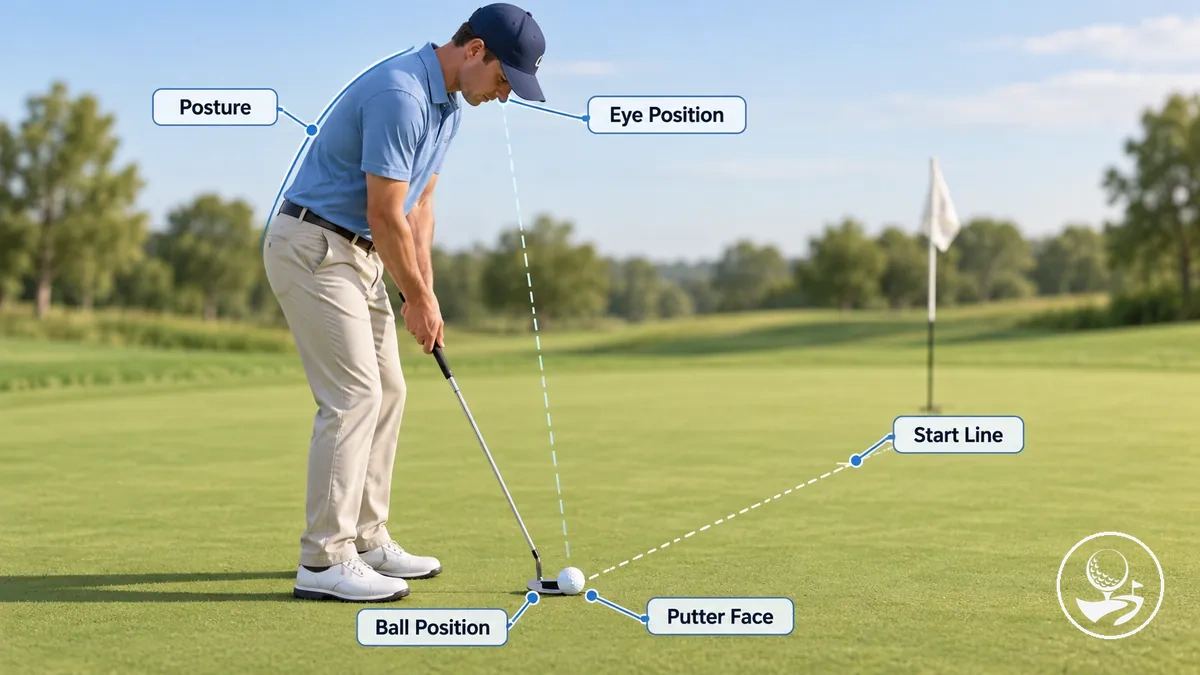
Changing several setup variables together removes the stable baseline needed to understand a missed start.
In practice: isolate the adjustment
If you change grip pressure, ball position and eye position after one missed putt, the next result cannot tell you which change mattered. Change one setup variable at a time while keeping the others steady, then compare repeated ball starts.
Build the putting address in a consistent sequence from body references toward the ball and face references.
Keep each action high level so the resulting setup remains repeatable while allowing individual posture and positioning to vary.
- Set the grip and posture in a comfortable reference position that can be reproduced.
- Align the body so the feet and upper-body references remain consistent with the intended setup.
- Position the ball at a repeatable location within the stance.
- Set the eye position and head position to create a consistent visual reference for the ball and start line.
- Orient the putter face to the chosen start line, then retain these reference conditions as the baseline for repeatability rather than forcing one fixed pose.
Set Grip, Posture and Body Alignment
Grip, posture, and body alignment should create a stable, comfortable putting address that supports repeatable putter delivery without forcing one fixed body position.
The annotated illustration shows how hand placement, relaxed arm hang, torso posture, and body lines relate around the ball and putter.
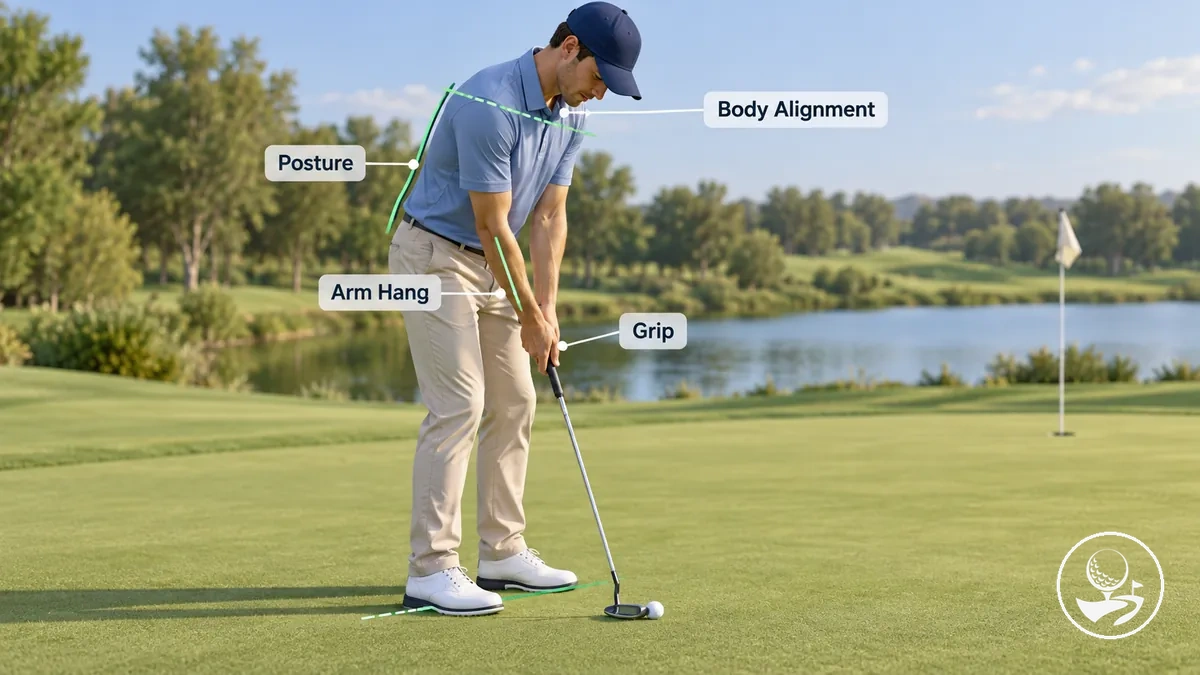
Workable stance width, body bend, arm hang, and hand position can differ with the golfer's proportions and comfortable address.
The useful condition is a position that allows the arms and hands to settle without unnecessary tension while remaining reproducible from putt to putt.
Grip pressure should be secure but not rigid: the hands must control the putter without creating unnecessary tension in the forearms.
Body alignment can support the intended line, but it is not the same as putter-face aim; the putter face is the more direct directional reference for the ball's start direction.
Treat the following as connected setup conditions rather than isolated fixes.
- Grip: Use a consistent hand relationship and manageable grip pressure so the hands and forearms can support controlled, repeatable delivery.
- Posture and arm hang: Set the torso and stance so the arms can hang comfortably toward the putter without requiring a rigid amount of bend.
- Body alignment: Arrange the shoulders, hips, knees, and feet as consistent body references that support the intended setup rather than forcing the putter face into position.
- Comfort and variation: Keep a reproducible baseline, then adjust stance width, bend, arm hang, or hand position when the change improves comfort or consistency for that golfer.
Set Ball Position for the Putting Stroke
Ball position is the ball's front-to-back location relative to the stance center and the point where the putter meets the ball.
It provides a repeatable reference for strike location and can influence how the putter face arrives relative to the intended start direction.
The annotated example shows the ball relative to the stance midpoint and a slightly forward reference zone without prescribing one exact measurement.
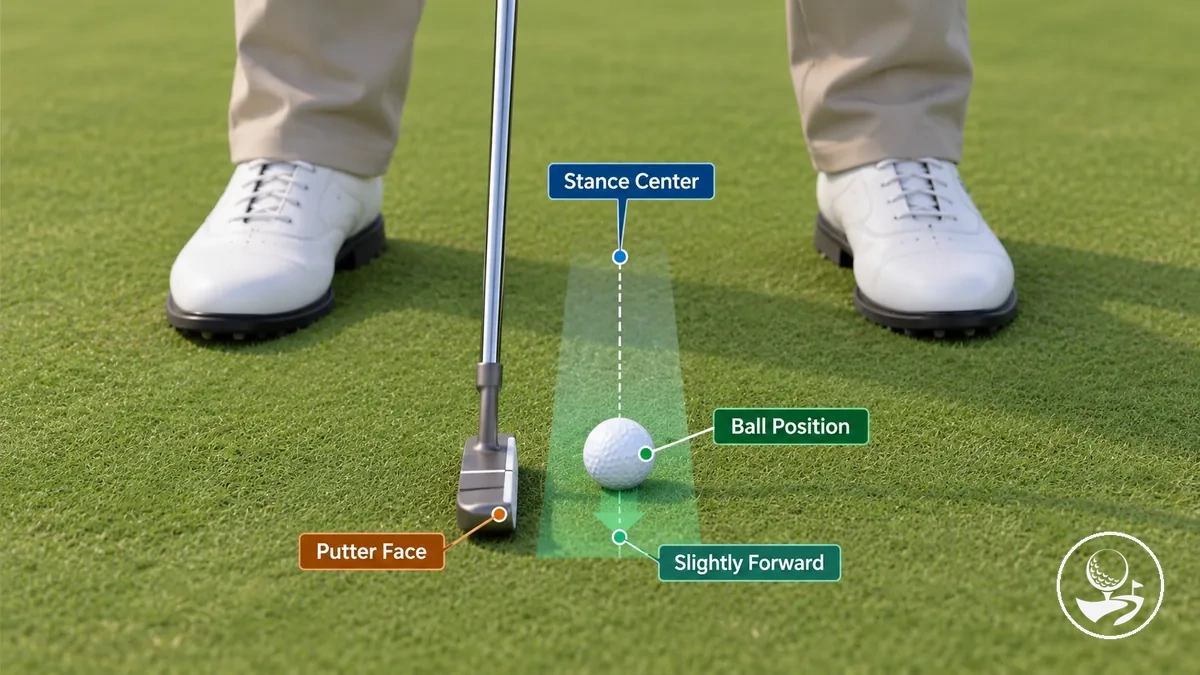
A useful beginner starting point is around the stance centre to slightly forward of centre. There is no single mandatory distance: posture and eye position affect how the ball's location looks and feels.
What changes when you move the ball?
- Move the ball forward
- Contact may occur later in the stroke, changing how the putter face arrives and where the ball is struck.
- Move the ball back
- Contact may occur earlier in the stroke, with a different delivered face position or strike location.
Keep your other setup references steady and compare contact consistency and initial direction over repeated putts. Prefer the position you can reproduce rather than an arbitrary measurement.
Set Eye Position for Consistent Alignment
Eye position is the relationship between the golfer's eyes, the ball, and the intended line at address.
It provides a visual reference for judging the ball and putter face, so a consistent head position helps the golfer compare alignment from one setup to the next.
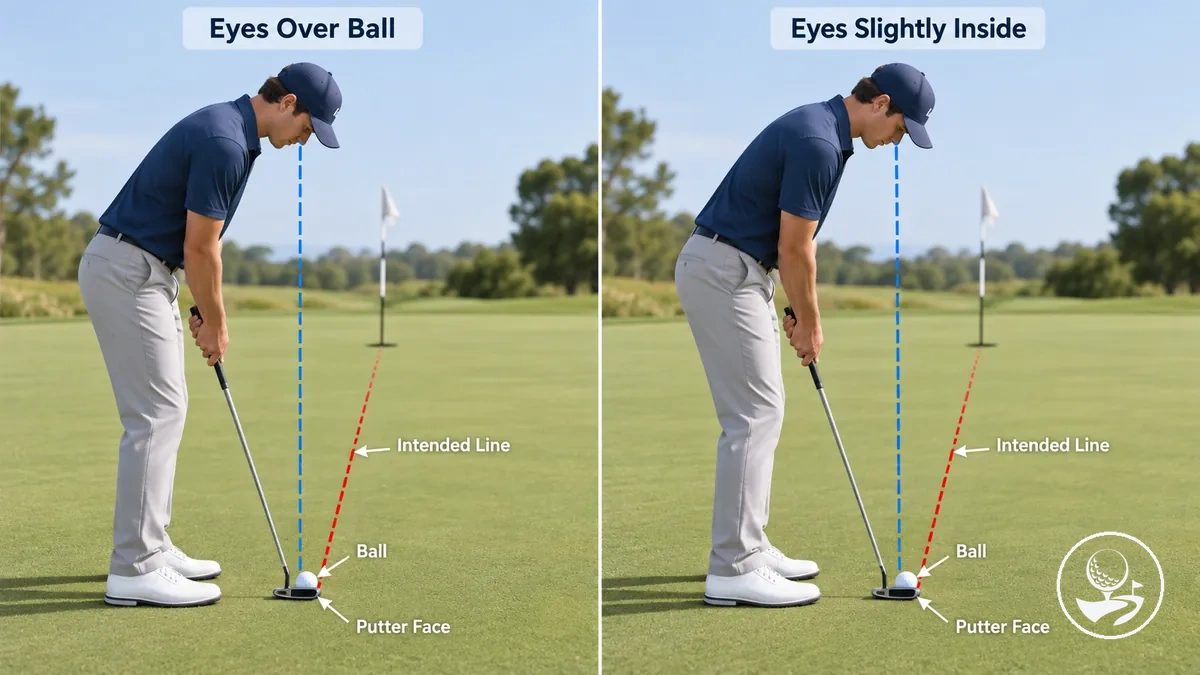
Two workable sightlines
- Eyes over the ball
- The visual reference is directly above the ball at address.
- Eyes slightly inside the ball
- The visual reference is closer to the golfer while still allowing a clear view of the chosen line.
Neither position is universally required. A head-position change can alter perceived alignment even if the ball and putter have not moved. Keep the same sightline for several putts from one spot, then compare perceived aim with repeated ball starts; one attempt cannot establish the best eye position.
Aim the Putter Face at the Intended Start Line
Aiming begins by choosing an intended start line and setting the putter face square to it at address: the putter's flat striking surface should be approximately perpendicular to the intended starting direction. The stroke must then deliver the face predictably at impact.
The annotated illustration shows the geometric relationship between face orientation, the ball, and the chosen start line, with a near intermediate target as an optional visual reference.
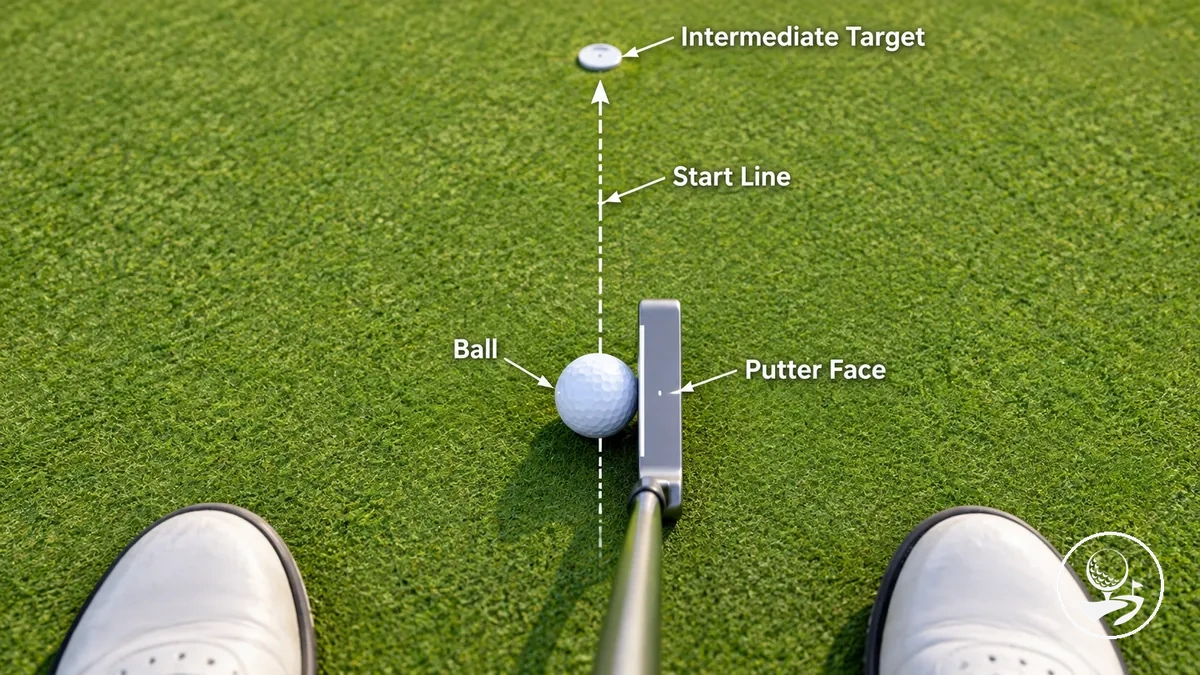
Body alignment can support the putting setup, but feet and shoulders do not by themselves define putter-face aim.
Putter-face orientation at impact generally has a stronger influence on the ball's initial direction than the stroke path, although both path and strike location can contribute. Settle the body around the aimed face rather than treating feet or shoulders as a substitute for checking it.
- Choose the start line you want the ball to begin on before addressing the putt.
- Select a near intermediate target on that intended line when a closer visual reference makes the direction easier to identify.
- Set the putter face square to the chosen line; if you use a ball alignment mark, point it along the same intended direction as a supporting visual reference.
- Settle your body alignment around the aimed putter face without shifting the face away from the chosen start line.
- Recheck the relationship among the putter face, ball, and intended line before starting the stroke, using the check as verification rather than a guarantee of the ball's final direction.
Make a Simple, Repeatable Putting Stroke
A repeatable putting stroke is a controlled motion that preserves the address conditions and delivers the putter face consistently through impact.
Keep posture and grip pressure stable enough for coordinated shoulder-and-arm motion. Use centred contact and a predictable initial ball direction as practical checks on the delivery.
The backstroke, transition, and follow-through can follow a natural arc rather than a perfectly straight visual path.
Stroke shape and rhythm may vary between golfers, so repeatability is better judged by stable face control and consistent contact than by forcing one universal motion or tempo ratio.
- Maintain the address: Begin the putting stroke without unnecessary changes in posture or grip pressure so the established setup remains a stable reference.
- Move through the backstroke: Let the shoulders and arms move the putter away from the ball in a coordinated motion, allowing the putter to follow its natural arc rather than forcing it along an artificial straight path.
- Keep the transition controlled: Change direction without a sudden acceleration or abrupt hand action, allowing the putter to return toward the ball with a repeatable rhythm.
- Deliver the putter through impact: Return the putter face predictably to the ball and use centered contact and ball start direction as references for how consistently the stroke is being delivered.
- Continue into the follow-through: Let the putter continue naturally after impact while maintaining face stability and the established rhythm. Evaluate the motion by repeatable delivery rather than expecting any single stroke to guarantee a result; detailed pace control is a separate putting skill.
Verify Alignment Through the Ball's Start Direction
The ball's initial start direction is a practical signal for checking whether putter-face aim and delivery are matching the intended line. Compare several attempts from the same spot; the final result of any one putt is less informative about directional control.
One miss is not enough to identify a cause because alignment perception, putter-face delivery, and strike quality can produce similar directional results.
The diagnostic flow below moves from the intended start line to the observed initial direction, then separates the next checks before a repeat test.
- Set the reference: Identify the intended start line before each test putt.
- Observe the signal: Note whether the ball start direction begins on the intended line, consistently left or right of it, or varies between attempts.
- Check alignment and the putter face: If starts repeatedly favour one side, compare perceived alignment with the putter face orientation at address and through impact.
- Check delivery and strike quality: If aim appears consistent, consider whether face delivery or changing contact across the putter face may be contributing to the observed direction.
- Repeat the test: Use the same intended start line again and compare several observations before interpreting the directional pattern.
Interpret the repeated pattern
- Mostly starts on the line
- The directional reference appears more consistent. If putts still miss, consider pace and green break rather than assuming the start line was wrong.
- Repeatedly starts left or right
- Compare face aim, face delivery at impact and strike quality. A directional pattern suggests a check, not a proven single cause.
- Starts on different sides
- Execution may be variable. Keep the setup and line steady, repeat the test and avoid diagnosing one isolated miss.
Common Putting Setup, Aim and Stroke Mistakes
Common putting mistakes often come from inconsistent setup, putter-face aim, or stroke delivery rather than one universal fault.
The same directional miss can have several plausible causes, so a recognition cue should be observed before choosing a corrective direction.
The table organizes each mistake by its likely consequence, an observable recognition cue, and a restrained adjustment to test.
Use the cues to identify a repeatable pattern; one missed putt is not proof of a particular fault.
| Mistake | Likely Consequence | Recognition Cue | Corrective Direction |
|---|---|---|---|
| Inconsistent ball position | May change where the putter meets the ball in the stroke and contribute to variable contact or start direction. | The ball appears noticeably farther forward or back relative to the stance from one putt to the next. | Test a repeatable ball-position reference while keeping the other setup conditions unchanged. |
| Changing eye position | Can alter the golfer's visual reference for the ball, intended line, and putter-face alignment. | The view of the ball and target line changes because the eyes occupy a different position at address. | Test a comfortable eye position that can be reproduced consistently rather than forcing one universal location. |
| Unstable head position | May change perceived alignment during the setup or stroke and make repeatability harder to judge. | The head visibly shifts, lifts, or rotates before or during contact. | Test a steadier head position through the stroke while avoiding unnecessary rigidity. |
| Inconsistent putter-face alignment | Can contribute to a ball start direction that repeatedly differs from the intended line. | The putter face appears aimed differently relative to the chosen start line across otherwise similar attempts. | Recheck face orientation against the same intended line before changing body alignment or other variables. |
| Excessive grip tension | May restrict coordinated motion and make putter delivery less repeatable. | The hands and forearms feel noticeably rigid or grip pressure increases during the stroke. | Test a lighter, controlled grip pressure that still maintains secure contact with the putter. |
| Excessive or poorly controlled face rotation | May produce changing putter-face orientation through impact and variable start direction. | The face appears to open or close by noticeably different amounts from stroke to stroke. | Test a more repeatable shoulder-and-arm motion without forcing the putter along an artificially straight path. |
| Inconsistent stroke rhythm | Can make the backstroke, transition, impact, and follow-through less repeatable. | The transition or overall stroke speed changes noticeably between similar putts. | Test a repeatable rhythm through the full motion without imposing a universal tempo ratio. |
Test one corrective direction at a time and compare repeated attempts before deciding whether the adjustment improves consistency.
Once a stable correction is identified, add putting to a practice routine so the same setup, aim, and stroke references can be repeated deliberately.